

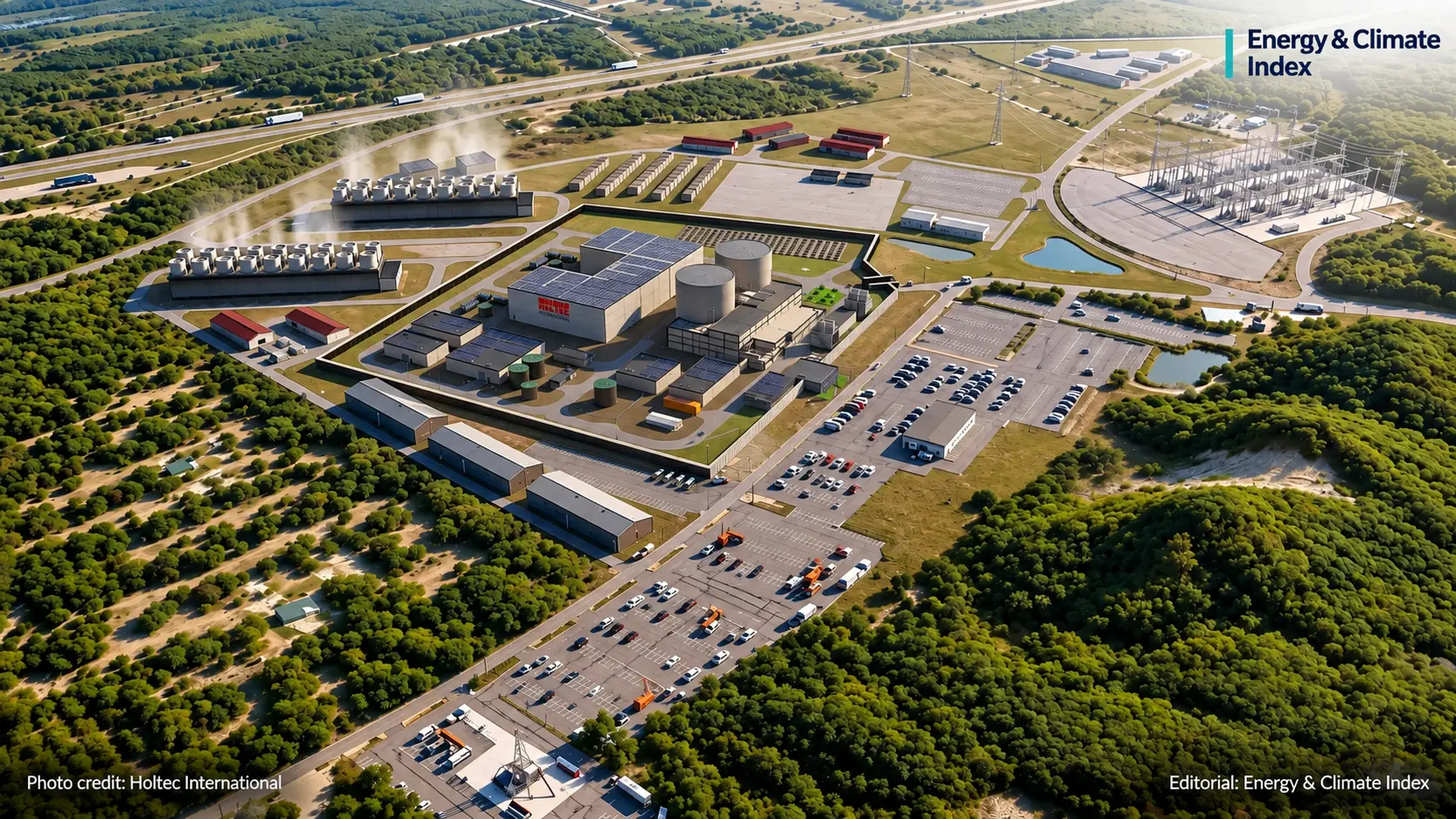
US-based Holtec International has taken another regulatory step toward the construction of two small modular nuclear reactors at the Palisades site in Michigan, with a combined planned capacity of 680 MW.
On September 30, the company submitted its Preliminary Safety Analysis Report to the US Nuclear Regulatory Commission (NRC), completing the second part of its construction permit application for Pioneer 1 and Pioneer 2.
The two reactors will use Holtec’s SMR-300 technology, with each unit designed for an electrical output of approximately 340 MW.


Two new reactors alongside the existing Palisades nuclear plant
The Pioneer project is part of the broader development of the Palisades energy complex in Covert Township, Michigan.
The site is also home to the existing 805 MW Palisades Nuclear Plant, which Holtec is preparing to restart.
With an additional 680 MW from Pioneer 1 and Pioneer 2, the site could reach approximately 1,485 MW of total nuclear generation capacity if the existing plant and both new reactors are operational.
The new report submitted to the NRC contains detailed technical and safety information required for the regulatory assessment of the project.
The process began with the submission of the first part of the application in late 2025. It included a request for limited authorization to carry out initial construction activities, such as site preparation and compaction, placement of engineered fill and foundation work.
In October 2026, the US regulator also formally published a notice regarding the receipt and availability of the first part of the phased construction permit application for the two reactors.
Holtec moves forward with the regulatory process for the SMR-300
Alongside the main application, Holtec is developing several technical solutions aimed at standardizing and accelerating the construction of its SMR-300 reactors.
One of these is a new construction method using factory-manufactured modules, tested in cooperation with Purdue University, which is intended to reduce on-site labor requirements compared with conventional construction methods.
In September 2026, the NRC completed its review of the documentation for this approach, while Holtec expects a safety evaluation in November.
The company is also developing standardized methodologies for analyzing soil-structure interaction under different seismic conditions, as well as a new architecture for instrumentation and control systems.
Pioneer 1 and Pioneer 2 are part of the broader US effort to move small modular reactors from technology development and licensing toward actual deployment.
However, the submission of the safety documentation does not mean that the project has received final authorization for construction or operation. The NRC must complete its regulatory and technical review, while additional licenses and safety approvals will be required before the reactors can begin operation.
If the project advances as planned, Palisades could become a rare example of a US nuclear site where a restarted large-scale nuclear power plant operates alongside a new generation of small modular reactors.
ECI