

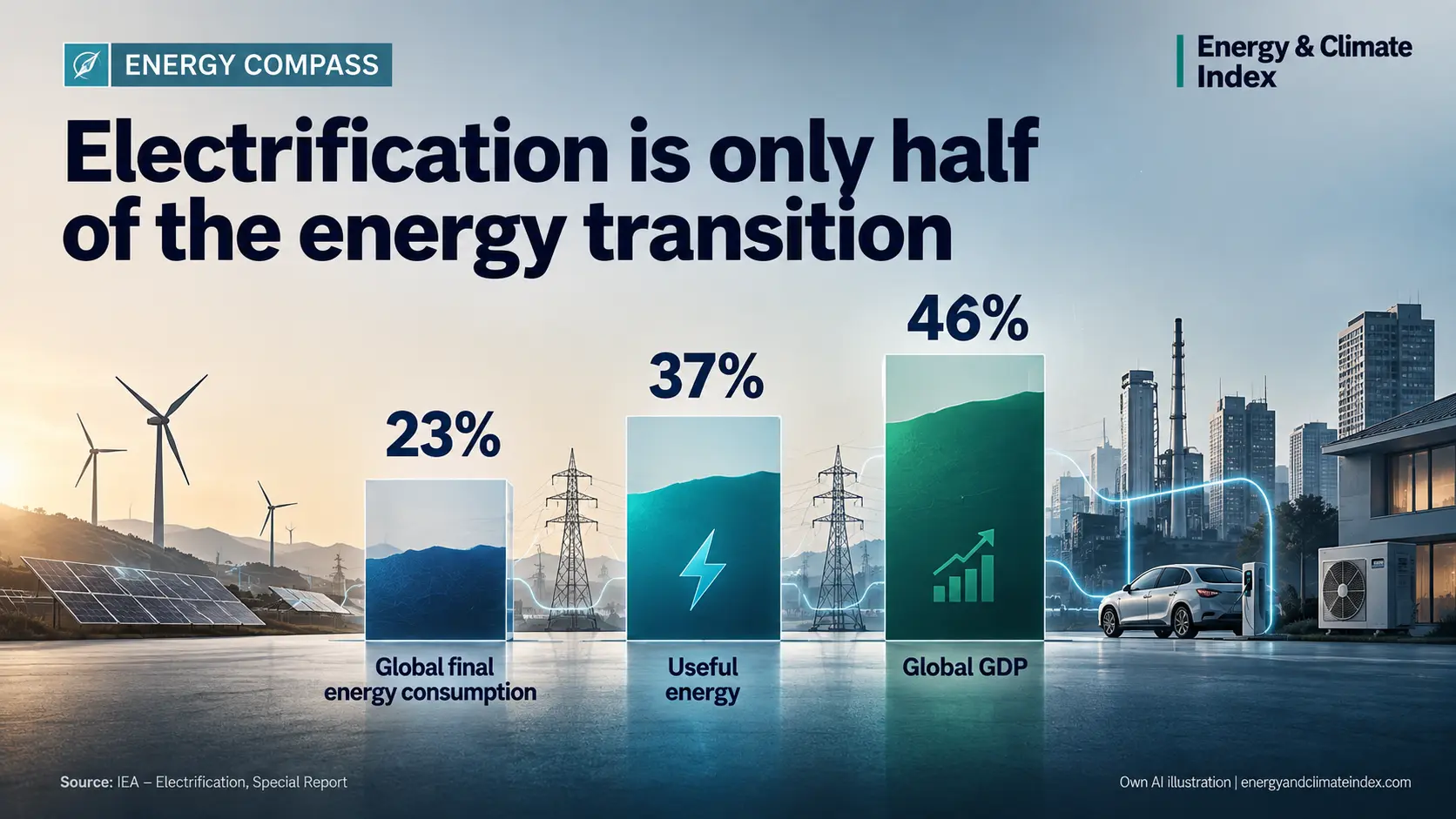
The world is entering what the International Energy Agency (IEA) calls the “Age of Electricity”. But one of the most interesting messages in its new Special Report on Electrification is not simply how much electricity we consume, but how much more energy service we obtain from it.
Electricity today accounts for only 23% of global final energy consumption, yet it provides 37% of useful energy and is the main source of energy for economic activities that generate 46% of global GDP.
These three figures explain the essence of electrification.


We do not need to replace all fossil energy
The key is not to replace every unit of fossil energy with one unit of electricity. What needs to be replaced are the services that fossil fuels provide transport, heating, cooling and industrial processes.
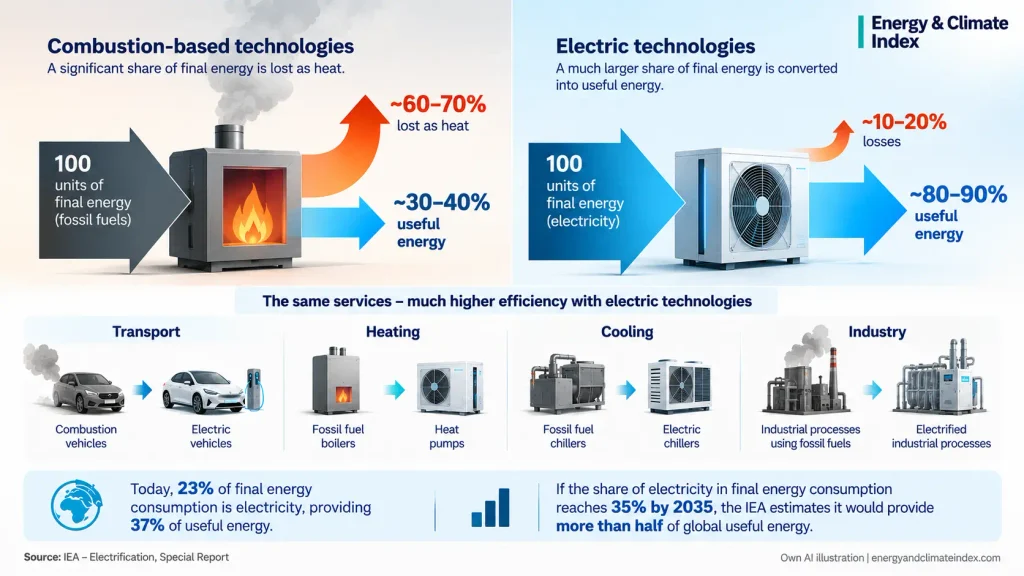
Electric technologies generally convert final energy into useful energy far more efficiently than combustion-based technologies, where a significant share is lost as heat.
This is why electricity, despite accounting for only 23% of final energy consumption today, provides 37% of useful energy. If electricity’s share of final consumption reaches 35% by 2035, the IEA estimates that it would provide more than half of global useful energy.
This is one of the most important, yet often overlooked, advantages of electrification: for many energy services, we do not need to replace vast quantities of fossil energy with an equivalent amount of electricity.
But what if the electricity comes from fossil fuels?
This is where the simple part of the story ends.
Electrification does not automatically mean decarbonisation.
An electric vehicle, a heat pump or an electrified industrial process can reduce the amount of final energy required. But the climate impact also depends on where the electricity comes from.
In 2025, low-emissions sources provided 42% of global electricity generation, yet the power sector still produced around 14 billion tonnes of CO₂ annually. The IEA therefore explicitly warns that electrification reduces emissions, but on its own is not enough to achieve climate goals.
The Agency also shows what could happen if electricity demand continues to grow while the power mix does not decarbonise quickly enough. Under such a scenario, natural gas consumption in the power sector would increase by around 430 billion cubic metres by 2035, while emissions from electricity generation would remain at around 14 Gt CO₂.
In that case, part of the problem would simply shift from the car, boiler or factory to the power plant.
The world will need much more electricity
If electricity’s share of final energy consumption reaches 35% by 2035, global electricity generation will need to increase by more than 15,000 TWh almost half of today’s global electricity generation.
That would require demand growth of around 1,400 TWh per year, nearly twice as fast as during the previous decade.
The IEA does not prescribe a single ideal energy mix for all countries. But the direction is clear: growing electricity demand must increasingly be met by low-emissions generation. For most power systems, this means accelerating the deployment of renewable energy alongside grids, energy storage and other sources of flexibility, while nuclear power plays an additional role in countries that already use it or plan to develop it.
At the same time, generation alone will not be enough. Electricity grids will need to be modernised and expanded around 40% faster through 2035 than during the previous decade, alongside the development of energy storage, demand-side management and other sources of flexibility.
Electrification is only half of the transition
The three figures 23%, 37% and 46% show why electricity is becoming the centre of the emerging energy system.
But electrification solves only one part of the equation.
It is not enough to connect cars, heating systems and industry to electricity. In parallel, we need to build an energy system capable of generating and delivering much larger quantities of electricity with progressively lower emissions.
Electrification reduces the amount of energy required to provide many services. Decarbonising the power system determines how clean that energy will be.
Therefore, the real challenge is not simply to electrify more, but to turn growing electricity demand into a driver of a cleaner, more efficient and more flexible energy system.
Viktor Andonov, M.Sc