

The Australian state of Victoria is introducing a new framework for data centre development, requiring the growth of AI and digital infrastructure to be accompanied by new investment in renewable energy, energy storage, electricity networks and sustainable water use.
On 22 September, the Victorian Government released its Sustainable Data Centre Action Plan, setting out expectations for the sector’s future development across energy, water, environmental and planning considerations.
New electricity demand should be supported by new generation
One of the key principles is that new data centres should match their additional electricity demand with new renewable energy generation and storage.


Under the new framework, operators will also be expected to take greater responsibility for the infrastructure required to connect their facilities, rather than allowing the costs created by large new electricity loads to be automatically passed on to the existing power network and its users.
This is particularly important because of the characteristics of data centres: high and relatively continuous electricity consumption, demanding reliability requirements and the concentration of large loads at a limited number of locations.
From around 5 TWh to 34 TWh
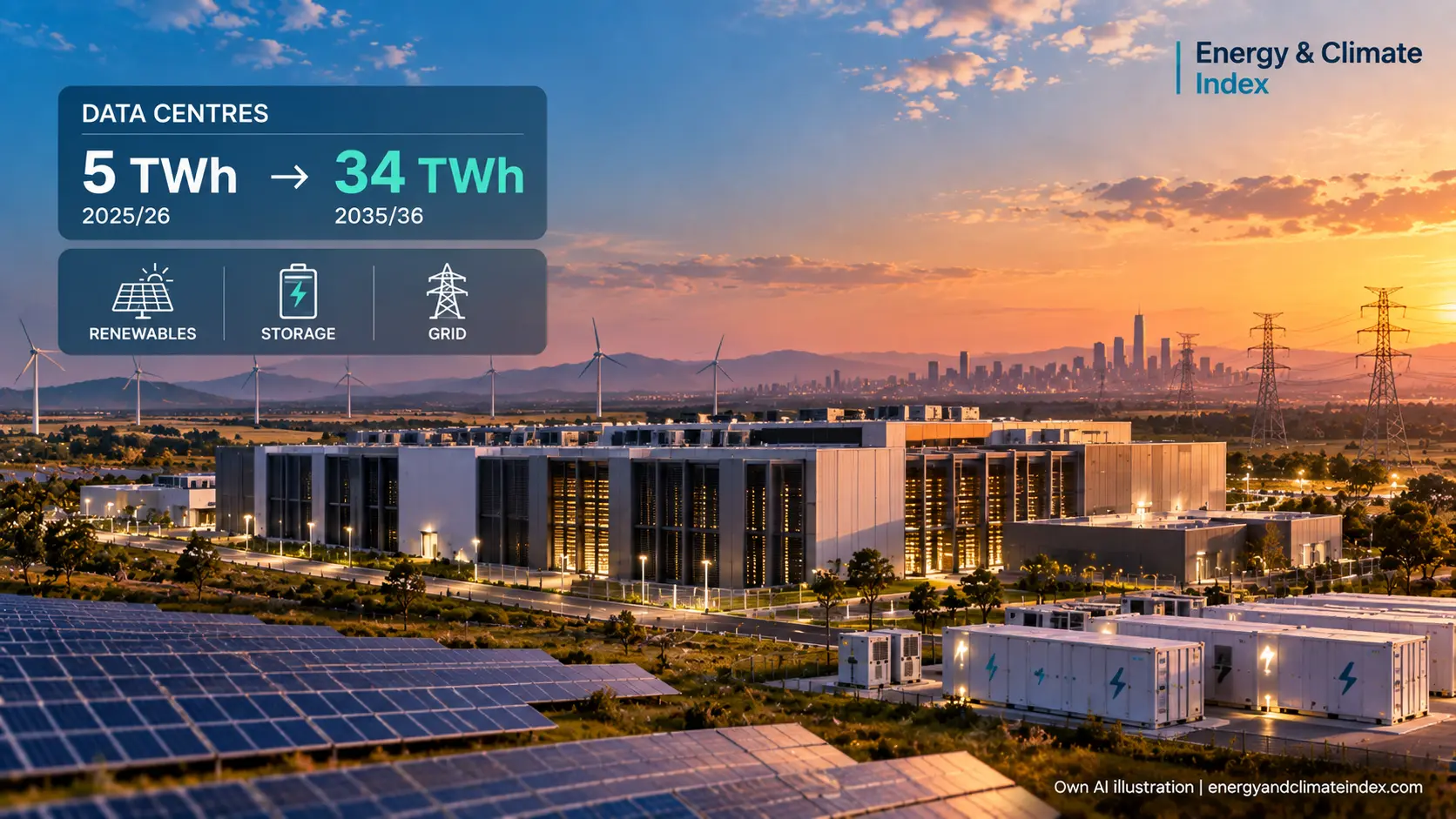
The scale of the challenge is significant. Electricity demand from data centres in Australia’s National Electricity Market (NEM) is expected to increase from around 5 TWh in 2025/26 to approximately 34 TWh in 2035/36.
This would increase their share of total electricity demand from approximately 3% to around 13% within a decade. The growth is being driven particularly by the rapid expansion of cloud infrastructure and AI computing.
Victoria’s new policy therefore links decisions on new data centres with available grid capacity, new electricity generation and storage systems, rather than treating them solely as planning or industrial investments.
Restrictions on water use and location
Energy is not the only resource covered by the new framework. New data centres will not be permitted in residential zones and will have to be located at least 150 metres away from homes.
Operators will also be expected to use recycled or other non-potable water where appropriate, with the aim of ensuring that the sector’s growth does not place additional pressure on drinking water resources.
At the same time, Victoria is not seeking to halt the sector’s development. The 2026–27 state budget provides AUD 5.5 million for the Sustainable Data Centre Action Plan as part of a broader strategy to support the development of the AI industry.
The new framework offers an interesting model for countries where the rapid expansion of AI infrastructure is beginning to collide with limited electricity grid capacity: investment in a data centre increasingly also means investment in new generation, energy storage and grid infrastructure.
ECI