

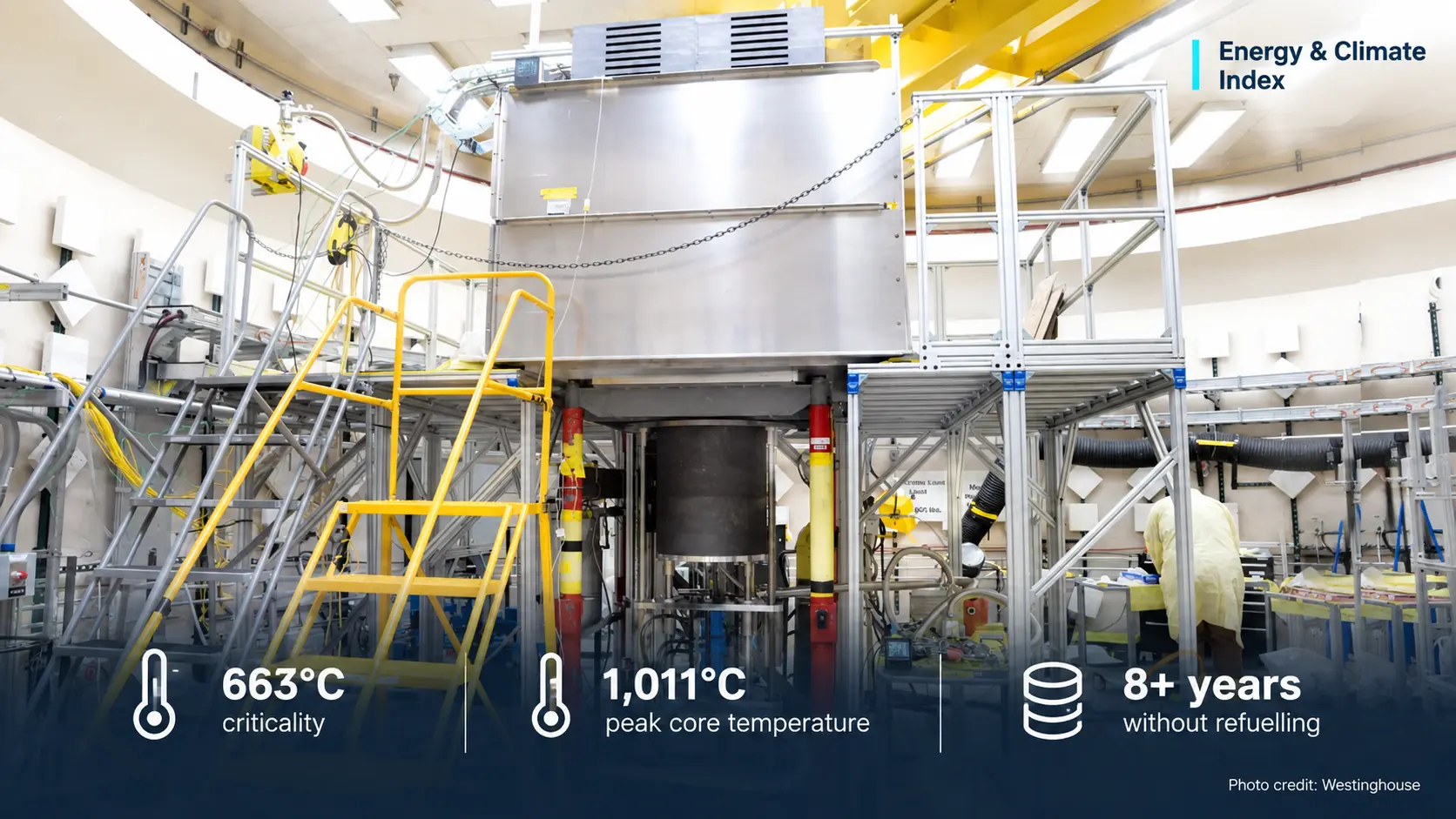
Westinghouse has successfully completed a new series of high-temperature criticality tests on its eVinci microreactor, designed to deliver 5 MW of electrical output and 15 MW of thermal power, marking a significant milestone in the development of a technology intended to provide reliable electricity for remote locations, industrial facilities and other users requiring continuous power supply.
On 3 September, the test achieved criticality at a temperature of 663°C, while researchers performed a reactivity measurement at a maximum core temperature of 1,011°C. According to Westinghouse and the U.S. Department of Energy, this represents a record-high temperature for such a measurement at the National Criticality Experiments Research Center (NCERC).
Testing under conditions closer to real operation
The testing was conducted in cooperation with Los Alamos National Laboratory and the Nevada National Security Site. Its purpose was to collect data on reactor material behaviour at temperatures approaching actual operating conditions.


The temperature-dependent data will be used to improve analytical models and support further development of the prototype. The latest phase follows zero-power criticality testing carried out in August, which validated key assumptions related to the reactor core design.
The eVinci design uses TRISO fuel, a graphite core and heat-pipe technology to transfer heat. The concept is considerably more compact than conventional nuclear reactors and is designed to be transported and deployed at different locations.
Up to eight years without refuelling
One of the main features of the eVinci concept is its ability to provide energy 24 hours a day for up to eight years without refueling.
Westinghouse is developing the technology for applications including remote and difficult-to-access locations, defence installations and other systems where security and continuity of energy supply are critical.
The U.S. Department of Energy said the results provide important data on reactor behaviour and will support the transition from experimental testing towards prototype development and potential future commercial deployment.
ECI