

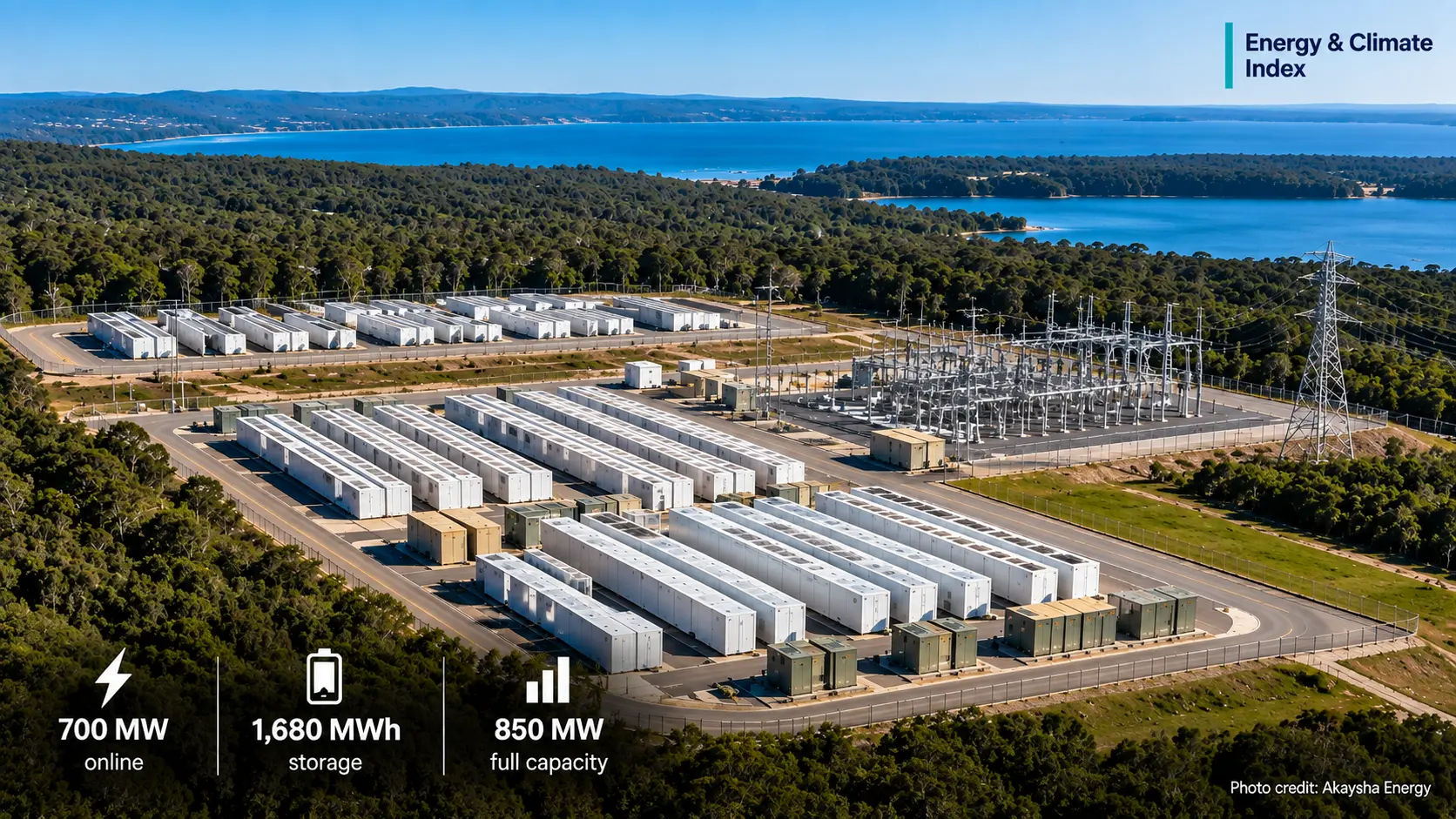
One of the world’s largest battery energy storage systems, the Waratah Super Battery in New South Wales, Australia, is now operating at 700 MW, while its full 1,680 MWh energy storage capacity is available.
Built at the site of the former Munmorah coal-fired power station, around 100 kilometres north of Sydney, the battery has a specific role in the electricity system: acting as a large-scale “shock absorber” for the grid during major system disturbances.
700 MW now available
Akaysha Energy has confirmed that the system is currently operating at 700 MW, representing around 82% of its total installed power capacity of 850 MW. Its full energy storage capacity of 1,680 MWh is already available.


Of the current 700 MW, 350 MW is dedicated to the System Integrity Protection Scheme, allowing the battery to respond rapidly to major disturbances in the electricity network.
The remaining 350 MW can participate in Australia’s National Electricity Market.
The full project configuration is 850 MW / 1,680 MWh, with the remaining capacity expected to become operational by the end of 2026.
A battery designed to protect the grid
Waratah is not a conventional battery project built only to store electricity when prices are low and sell it back when prices rise.
The project forms part of a broader system that includes the battery itself, a central control system, transmission network upgrades and additional generation capacity.
During sudden outages or other major disturbances, the system is designed to respond rapidly and allow larger volumes of electricity to flow through the existing transmission network towards Sydney, Newcastle and Wollongong.
This function is becoming increasingly important as New South Wales gradually retires its coal-fired power plants.
Large batteries take on a new system role
Waratah illustrates how the role of battery storage is changing as renewable generation expands.
Batteries are no longer used only to shift electricity from low-price to high-price periods. Large-scale BESS projects are increasingly becoming critical infrastructure for grid stability, rapid response to system failures and more efficient use of existing transmission capacity.
In Waratah’s case, this function is at the heart of the project, a large battery that can participate in the electricity market while simultaneously providing protection for the wider power system.
ECI