

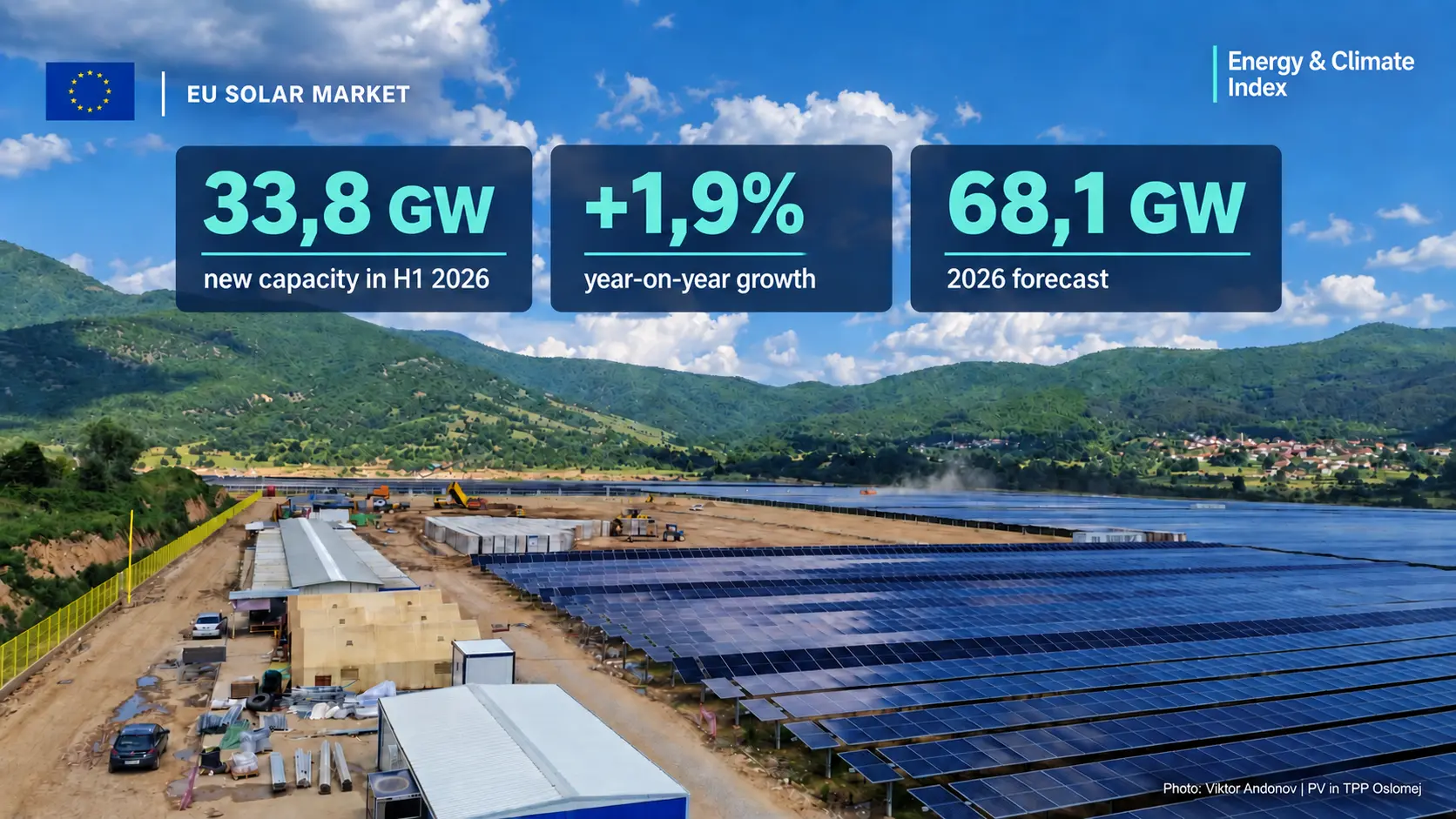
SolarPower Europe raises its full-year forecast to 68.1 GW but still expects a 2.1% decline. Solar supplied a record 25% of EU electricity in June
The European Union installed at least 33.8 GW of new solar PV capacity in the first half of 2026, representing an increase of 1.9% compared with the 33.2 GW added during the same period last year.
The result was better than previously expected, but it does not mark the beginning of a new period of strong growth, according to SolarPower Europe’s latest EU Solar Market Update.
The market was supported by renewed increases in fossil fuel prices and growing energy security concerns. At the same time, policy, regulatory and grid conditions have not improved across most EU member states.


The figures for the first half of 2026 remain preliminary. Complete monthly statistics were available for 14 EU countries, which accounted for around 85% of the bloc’s solar market in 2025.
Five countries delivered three quarters of new capacity
Germany remained the EU’s largest solar market, installing around 7.5 GW of new capacity, although this was 4% below the level recorded in the first half of 2025.
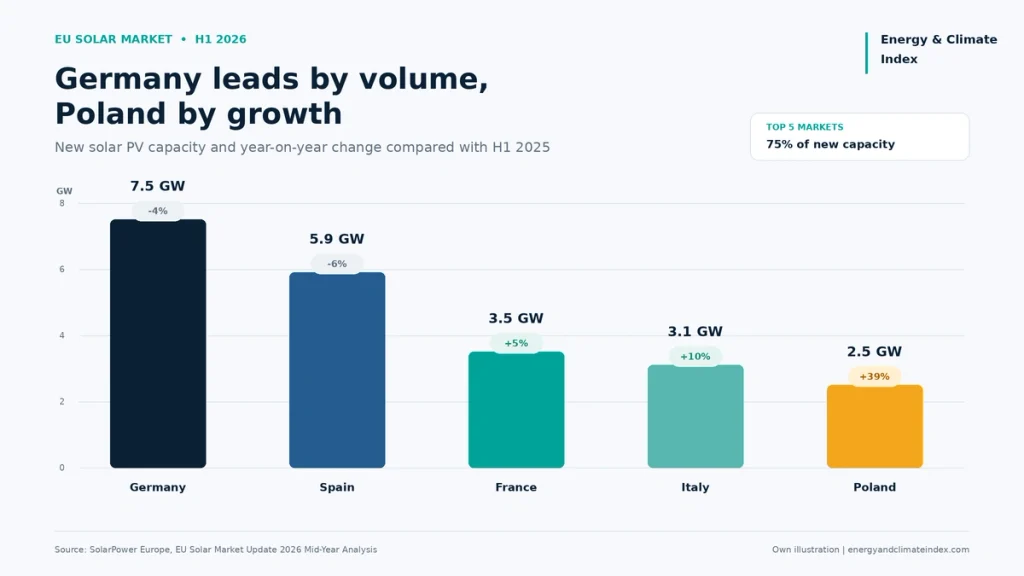
Spain added 5.9 GW, a year-on-year decline of 6%. France, Italy and Poland, meanwhile, continued to grow.
France installed 3.5 GW, an increase of 5%, while Italy added 3.1 GW, up 10%. Poland recorded the fastest growth among the five largest markets, adding almost 2.5 GW, or 39% more than in the first half of 2025.
Together, Germany, Spain, France, Italy and Poland accounted for approximately 75% of all new solar capacity installed in the EU.
Romania added around 1.8 GW, compared with 1.5 GW a year earlier. Greece installed approximately 1.5 GW in only six months, almost matching the capacity it added during the whole of 2025.
Smaller markets also expanded rapidly. Latvia installed around 600 MW, while Finland commissioned 478 MW across eight large-scale solar projects.
A slight decline is still expected for the full year
Following the stronger-than-expected first-half results, SolarPower Europe raised its central forecast for 2026 from 61.5 GW to 68.1 GW.
However, this would still represent a 2.1% decline from the revised record of 69.6 GW installed in 2025. Depending on market developments during the remainder of the year, the possible outcome ranges from 62 GW to 74.1 GW.
Utility-scale solar – mainly ground-mounted systems above 1 MW is expected to account for 56% of newly installed capacity. The share of rooftop solar is forecast to fall from 45% in 2025 to 44% in 2026, largely because of weaker residential demand in several mature markets.
According to the analysis, the market’s resilience in 2026 has been driven more by the renewed energy shock and higher fossil fuel prices than by improvements in solar policy and regulatory frameworks.
Solar was the EU’s largest power source in June
By the end of June, the European Union had around 445 GW of operational solar PV capacity.
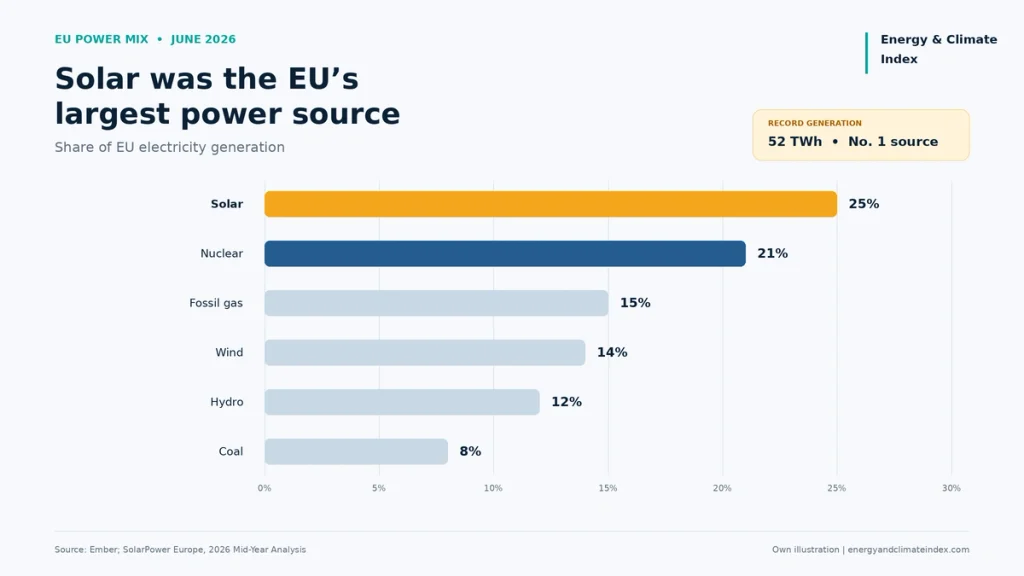
Solar generated more than 20% of the EU’s electricity in May, June and July. Its share reached a record 25% in June, making solar the bloc’s largest single source of electricity during the month.
In 14 EU countries, solar supplied at least 30% of electricity generation during at least one month in 2026. Latvia reached 62%, Luxembourg 61% and Estonia 52%.
Between 1 March and 31 August 2026, the EU’s solar fleet generated 282 TWh of electricity. According to SolarPower Europe’s calculations, this avoided approximately €30 billion in natural gas import costs, more than €1 billion per week as well as an additional 119 million tonnes of CO₂ emissions.
Solar generation is growing faster than system flexibility
Record solar generation is increasingly exposing Europe’s shortage of battery storage, flexible demand and grid capacity.
High daytime generation reduces wholesale electricity prices, but power systems become more dependent on expensive fossil fuel plants when solar output declines in the evening. During the heatwave in late June, evening prices exceeded €1,000/MWh in Belgium and reached €747/MWh in Germany.
The EU battery storage market is expected to add around 52 GWh in 2026, an increase of 44% compared with 2025. However, SolarPower Europe warns that the deployment of storage, electricity grids and flexible demand is still failing to keep pace with the expansion of solar generation.
Without more stable regulation and faster investment in these areas, the EU is likely to miss its target of 750 GW of solar capacity by 2030 and by a significant margin.
ECI