

The Government has instructed the electricity market operator to prepare a plan covering the organizational, technical, regulatory and financial requirements for establishing the new function
MEMO, which currently operates the organized electricity market, is required to prepare a comprehensive plan outlining the organizational, technical, IT, legal and financial conditions necessary to assume the new function.
The legal framework for organising and operating the natural gas market was introduced under the 2018 Energy Law. However, a dedicated and fully operational market operator has not yet been established for this segment.
According to the Ministry of Energy, an analysis of regional models showed that establishing a new company would require more time and entail additional administrative and operating costs. The Government therefore selected a model under which MEMO will assume the responsibility, drawing on its existing IT infrastructure and experience in market settlement.


The future operator will be responsible for organising and administering the natural gas market, registering market participants, calculating and financially settling imbalances, and publishing relevant market information.
The market is liberalised but remains small and highly concentrated
According to the Energy Regulatory Commission’s Annual Report for 2025, the natural gas market has been fully liberalised since 2015. Nevertheless, it remains underdeveloped, with relatively low consumption and a limited number of active traders and suppliers.
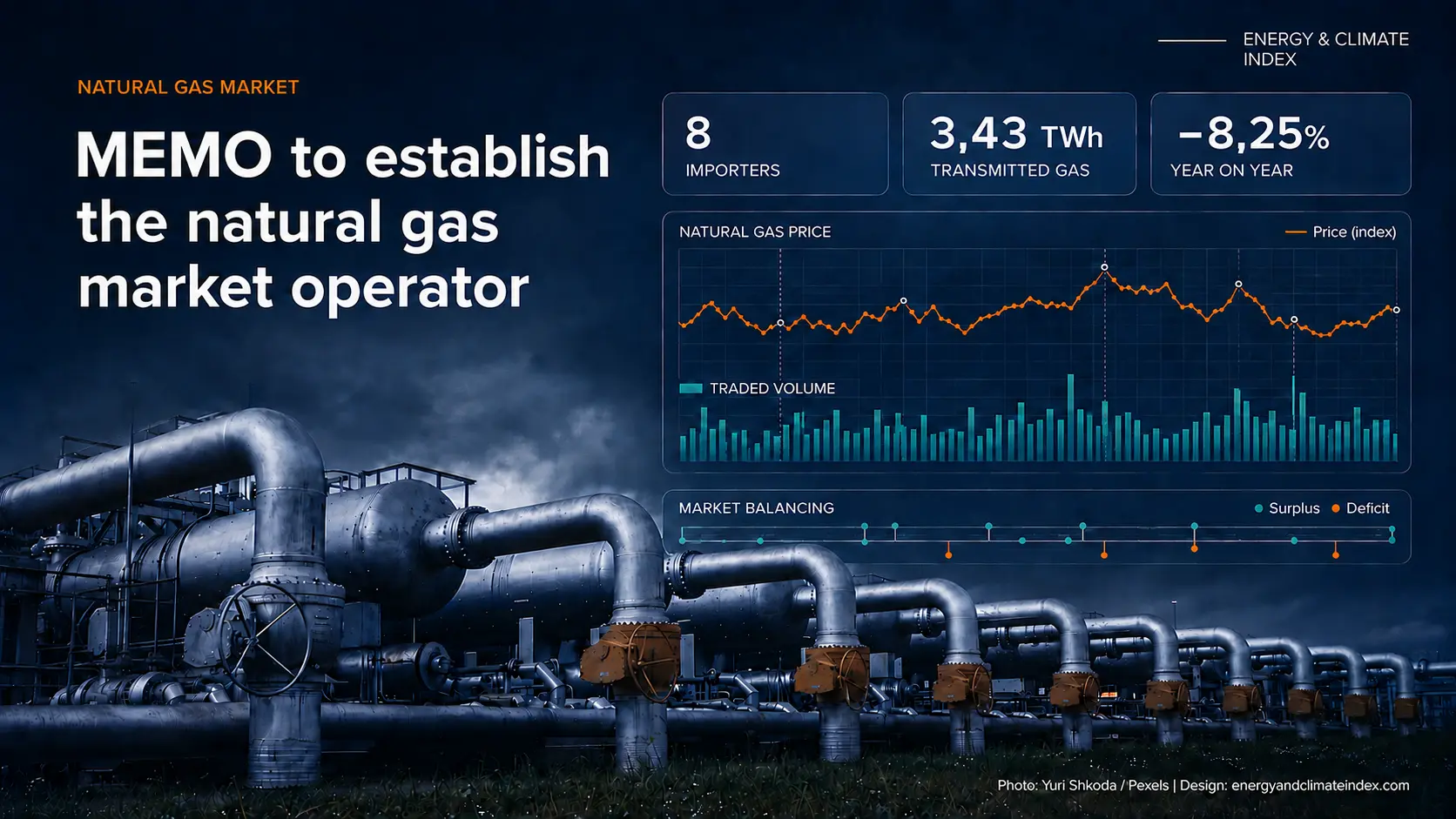
Eight traders imported natural gas in 2025, the highest number recorded to date. A total of 3.43 TWh of natural gas was transported through the transmission system, representing a decrease of 8.25% compared with 2024. Consumption amounted to approximately 296 million cubic metres, remaining well below the record level of 426 million cubic metres registered in 2021.
Despite the increased number of importers, the market remains highly concentrated. TE-TO Skopje accounted for 70.9% of imports and wholesale trading, while Makpetrol held a share of 20.1%. The Energy Regulatory Commission noted that TE-TO uses most of the imported gas for its own electricity and heat production rather than for conventional trading activities.
Approximately 84% of natural gas was consumed by combined heat and power plants and district heating facilities. Industrial consumers directly connected to the transmission system accounted for 14%, while only 2% of total volumes were consumed through the country’s three distribution systems.
The average import price in 2025 was €47.4/MWh, compared with €38.8/MWh in 2024. North Macedonia continues to import its entire natural gas supply through its sole interconnection with Bulgaria.
ECI