

Europe is entering a new phase in assessing whether its electricity system will have sufficient resources to ensure secure supply over the next decade. ENTSO-E has published an implementation plan for the revised European Resource Adequacy Assessment (ERAA) methodology, the key European framework for assessing the adequacy of the electricity system.
The change comes at a time when Europe’s electricity system is undergoing rapid transformation: wind and solar generation is expanding, the role of battery storage and demand-side response is growing, while some existing thermal power plants are facing increasing economic pressure.
The new methodology was formally approved by the European regulator ACER on 17 March 2026, while ENTSO-E published its implementation plan on 31 July. Some of the new elements are already being introduced in ERAA 2026, with broader implementation planned for subsequent assessment cycles.


From the energy crisis to a new approach to security of supply
The revision has its roots in the 2021–2022 energy crisis and the subsequent reform of the European electricity market.
Following changes to European legislation that entered into force in July 2024, capacity mechanisms are no longer treated exclusively as temporary measures or a last resort. Instead, they are taking on a more structural role in Europe’s framework for ensuring security of electricity supply.
This is an important shift. In a system with an increasing share of weather-dependent generation, the question is no longer simply how much electricity can be produced over the course of a year, but whether sufficient resources will be available during every critical period to meet demand.
This is where ERAA plays a central role.
What does ERAA actually assess?
The European Resource Adequacy Assessment is a pan-European analysis through which ENTSO-E assesses electricity system adequacy risks up to ten years ahead.
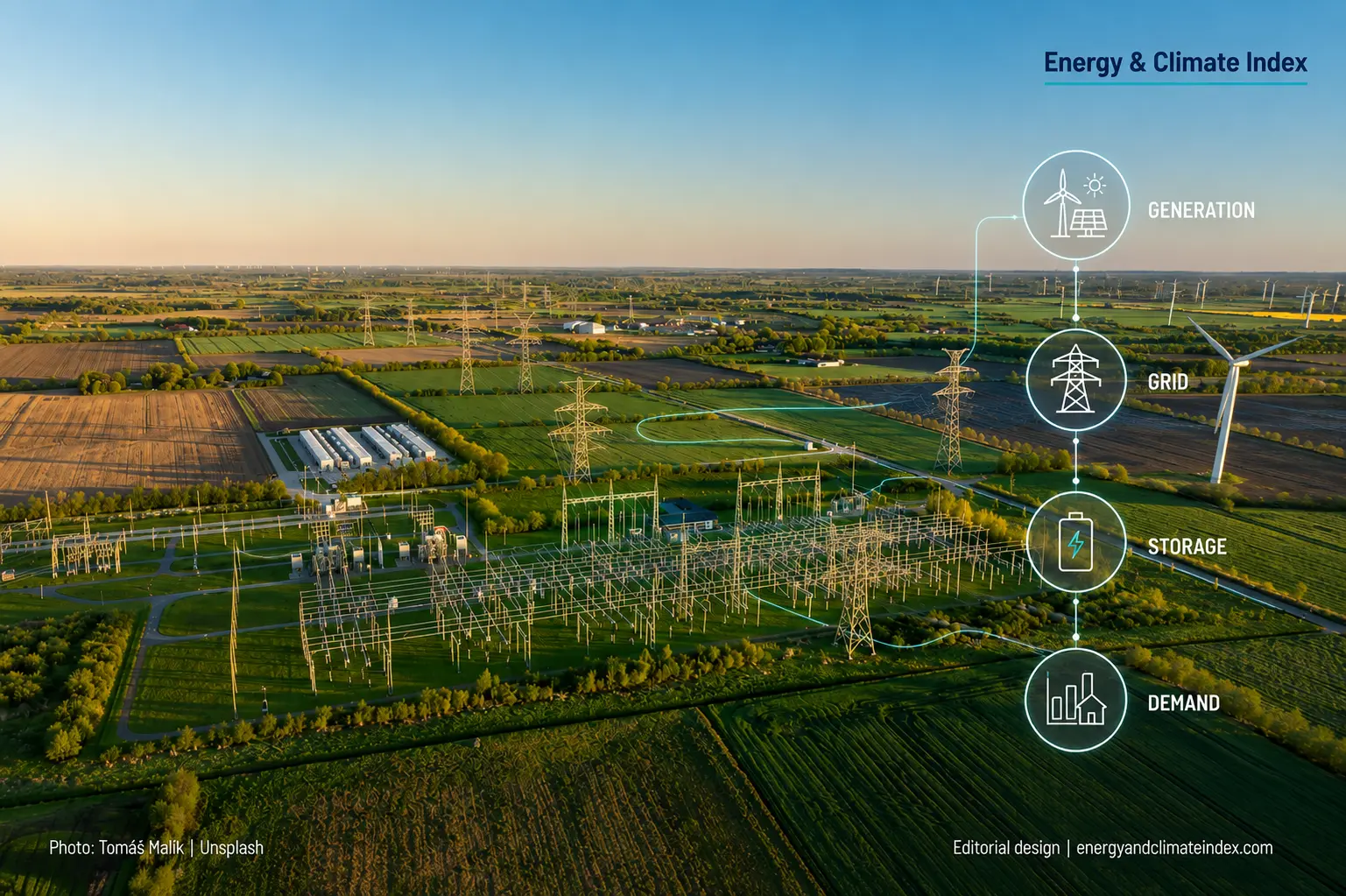
The modelling goes far beyond installed power generation capacity. The assessment takes into account electricity generation, demand, energy storage, demand-side response, cross-border interconnections, the economic viability of existing and future capacity, and different weather scenarios.
Its purpose is to identify where and when there may be a risk that the system will not have sufficient available resources to meet electricity demand.
This is precisely why ERAA results are directly relevant to decisions by countries considering the introduction or continuation of capacity mechanisms.
Batteries and flexibility become part of the equation
The change is particularly important given the way Europe’s electricity system is evolving.
Resource adequacy no longer depends solely on how many conventional power plants are available. Electricity storage, demand-side response, cross-border exchanges and other sources of flexibility are playing an increasingly important role in covering periods when electricity generation and demand do not match.
At the same time, the economic viability of existing power plants is becoming an important part of the assessment.
The latest ERAA 2025 already showed that a significant share of fossil-fuel capacity could become economically unviable over the next decade because revenues from the electricity market alone may not be sufficient to keep these plants in operation. ENTSO-E warned that significant capacity could be at risk of closure as early as 2028 and 2030.
This creates a new dilemma for European energy policy: how to accelerate decarbonisation while simultaneously ensuring that sufficient flexible capacity is available when the system needs it most.
Europe wants a simpler but more robust model
In March 2025, the European Commission concluded that the process for approving capacity mechanisms was complex, while the complexity of the ERAA methodology itself had also been subject to criticism.
ACER therefore asked ENTSO-E to propose changes that would make the model simpler to implement while keeping it sufficiently robust to assess risks in a rapidly changing electricity system. The proposal was prepared following consultations with stakeholders, and the final revised methodology was approved in March this year.
ERAA 2026, which is currently being prepared, will be the first assessment to begin applying elements of the new approach. Publication of the report is planned for the end of 2026.
Security of the electricity system takes on a new meaning
The ERAA revision reflects a broader shift in European energy policy.
In a system where wind and solar power are expanding rapidly, the question of security is increasingly shifting from simply having enough generation capacity to ensuring that resources are available at the right time.
This means that in the next phase of Europe’s energy transition, batteries, demand-side response, interconnections and other sources of flexibility will carry increasing weight in determining whether the system can reliably meet electricity demand.
The new ERAA methodology should provide a clearer picture of exactly that, not simply how many power plants Europe has, but which resources can actually be available when the electricity system is under the greatest pressure.
Viktor Andonov, M.Sc