

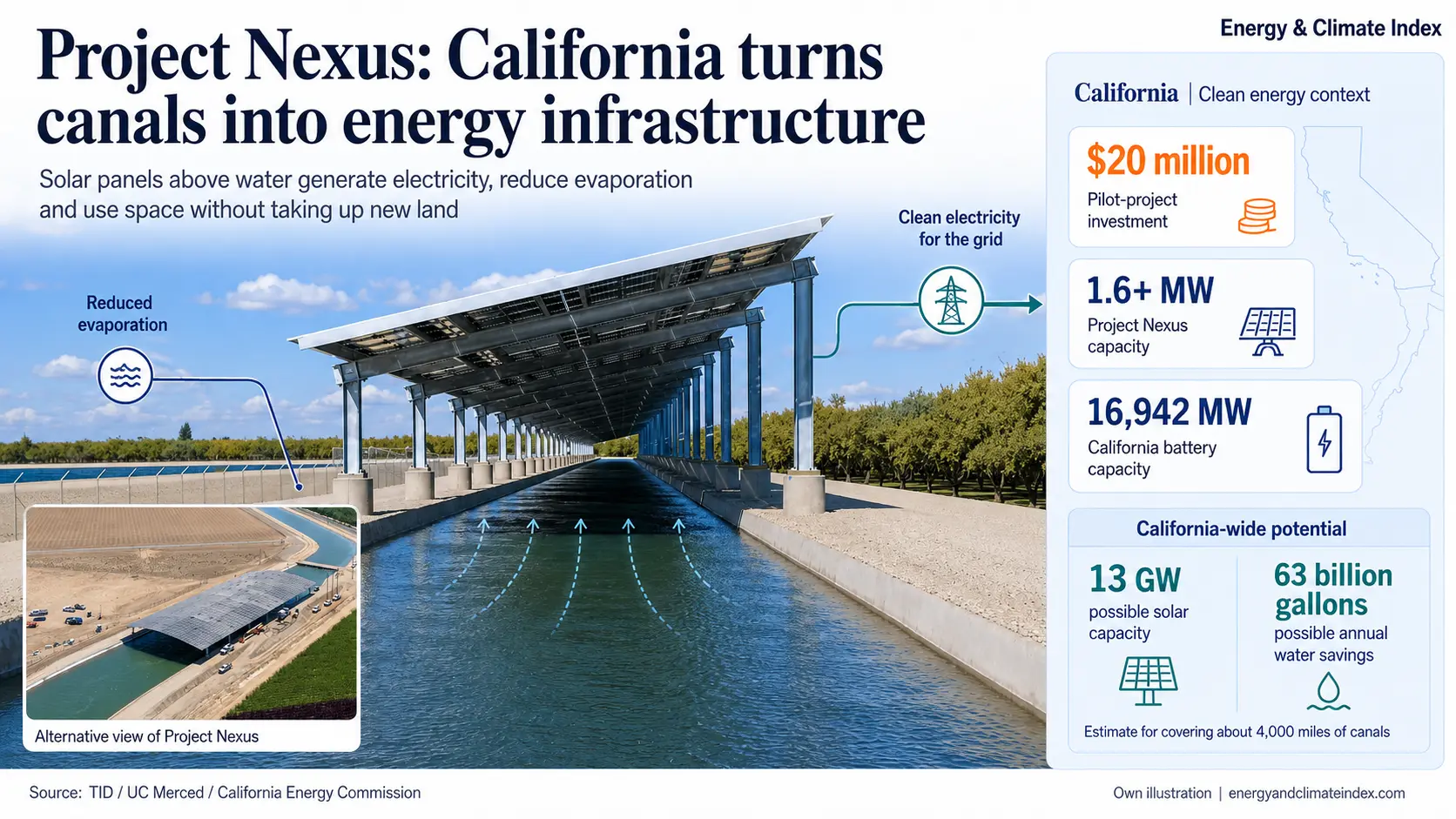
The $20 million Project Nexus pilot will examine whether existing water infrastructure can simultaneously generate electricity, reduce evaporation and lower maintenance costs.
California has completed Project Nexus, a pilot project featuring solar panels installed above an irrigation canal in the Central Valley. The innovative solution brings together two infrastructure functions within the same space: renewable electricity generation and water conservation.
The project represents a $20 million investment financed by the State of California. With construction complete, testing under real-world conditions will now determine how much electricity the panels can generate and how much water can be conserved by reducing evaporation.


Existing infrastructure gains a new function
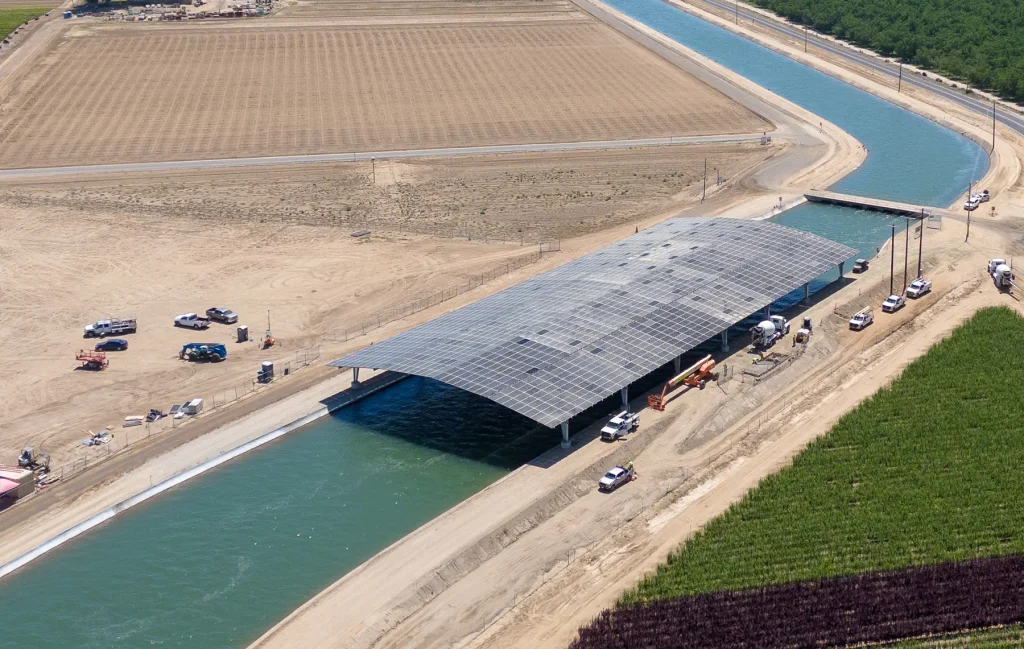
The project’s main advantage is its use of the space above existing canals. Installing the panels does not require additional land, while the canal becomes both a water-delivery system and a site for renewable electricity generation.
The shade provided by the panels could reduce water heating and evaporation. At the same time, limiting direct sunlight could slow vegetation growth inside the canal and reduce the need for cleaning.
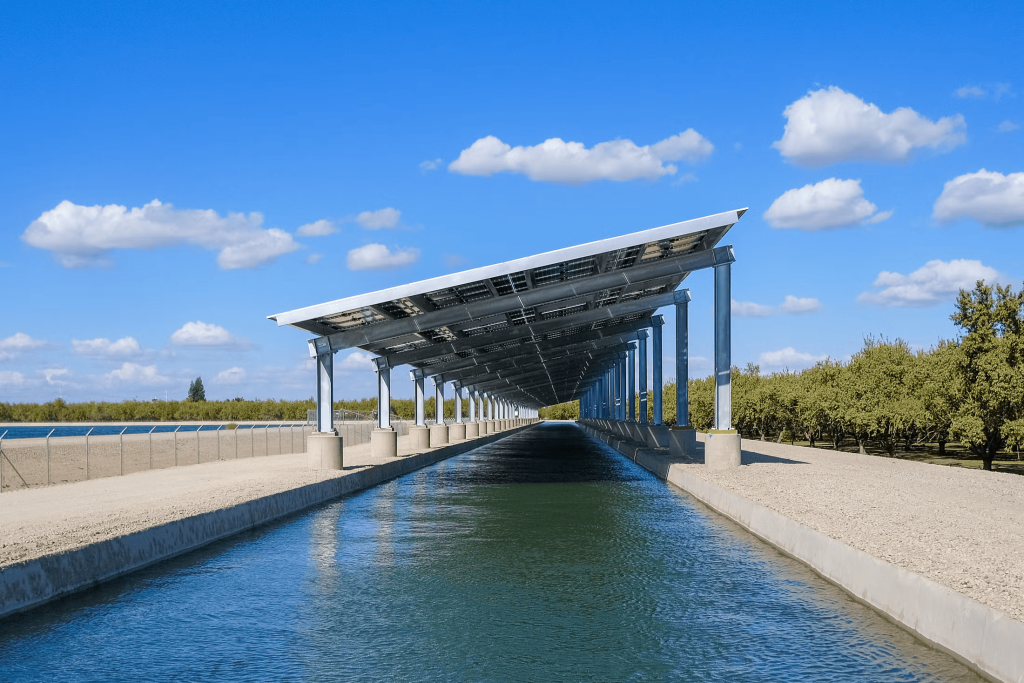
Maintenance costs are among the parameters that will be monitored during the pilot. Turlock Irrigation District spends millions of dollars annually maintaining its canal infrastructure, and the research will examine whether solar coverage can reduce some of these expenses.
Economic viability has yet to be demonstrated
Project Nexus is a partnership between the California Department of Water Resources, Turlock Irrigation District, SolarAquaGrid and the University of California, Merced. In addition to electricity generation and water conservation, researchers will examine potential improvements in water quality and overall system efficiency.
An earlier UC Merced analysis estimated that installing solar panels over California’s open canals could prevent the evaporation of billions of gallons of water annually. However, Project Nexus must now establish the scale of the benefits under real operating conditions and determine whether the concept can be economically deployed on a larger scale.
For regions facing drought, high temperatures and growing electricity demand, solar-covered canals offer a different approach. Instead of requiring additional land, new energy infrastructure can be integrated into systems that are already in operation.
Project Nexus provides more than 1.6 MW of capacity
The pilot has been deployed at two locations on narrow and wide sections of Turlock Irrigation District’s canal network. According to TID, Project Nexus provides more than 1.6 MW of renewable generation capacity.
A 75 kW iron-flow battery system has also been integrated at the narrow-span site. It will support research into the interaction between solar generation, energy storage and the local electricity grid.
The exact water savings achieved by the project are not yet known. Measuring evaporation reduction is one of the central objectives of the research being conducted by UC Merced.
The university’s broader analysis estimated that covering approximately 4,000 miles of California’s canals could provide around 13 GW of solar capacity and save 63 billion gallons of water annually. These figures represent estimated statewide potential, not measured results from Project Nexus.
California has nearly 17 GW of battery storage
Project Nexus forms part of California’s broader energy transformation. According to the California Energy Commission, the state had 16,942 MW of battery storage available by November 2025.
That represents an increase of approximately 2,100% since Governor Gavin Newsom took office in 2019. More than 30,000 MW of new energy resources have also been added to California’s electricity grid during this period.
Battery deployment is particularly important for integrating solar energy because it allows part of the electricity produced during the day to be stored and delivered in the evening, when solar generation declines but demand remains high.
California has already installed approximately one-third of the storage capacity it estimates will be required by 2045 to meet its clean-energy objectives. The state projects that it will need around 52,000 MW of battery storage by then.
Two-thirds of electricity came from clean sources
In 2023, clean sources supplied approximately two-thirds of California’s electricity, making it the world’s largest economy to reach that level, according to the state administration.
In 2025, clean electricity met or exceeded total demand on the California Independent System Operator grid during part of the day on 279 days. California ISO manages approximately 80% of the state’s electricity system.
This does not mean California operated exclusively on clean electricity throughout those days. It means that during certain hours, clean generation was sufficient to meet or surpass the demand recorded on the California ISO grid.
Energy storage plays a central role in extending the benefits of high daytime solar production into the evening. The rapid expansion of batteries and innovative models such as solar-covered canals are therefore connected components of the same energy transition.
Nearly $1 billion in new clean-tech investment
In 2026, California also welcomed a commitment of nearly $1 billion in clean-technology investment through cooperation with UK-based Octopus Energy. The commitment is part of the state’s wider effort to attract capital for clean energy, storage and emerging energy technologies.
Project Nexus is much smaller in financial terms, but its importance lies in testing a new model for integrating infrastructure. If the pilot demonstrates measurable water savings, reliable electricity production and lower maintenance costs, the concept could be replicated across other parts of California’s extensive canal network.
The space above canals could therefore become an additional energy resource without occupying new land, while also supporting water conservation in a state increasingly exposed to drought and higher temperatures.
ECI