

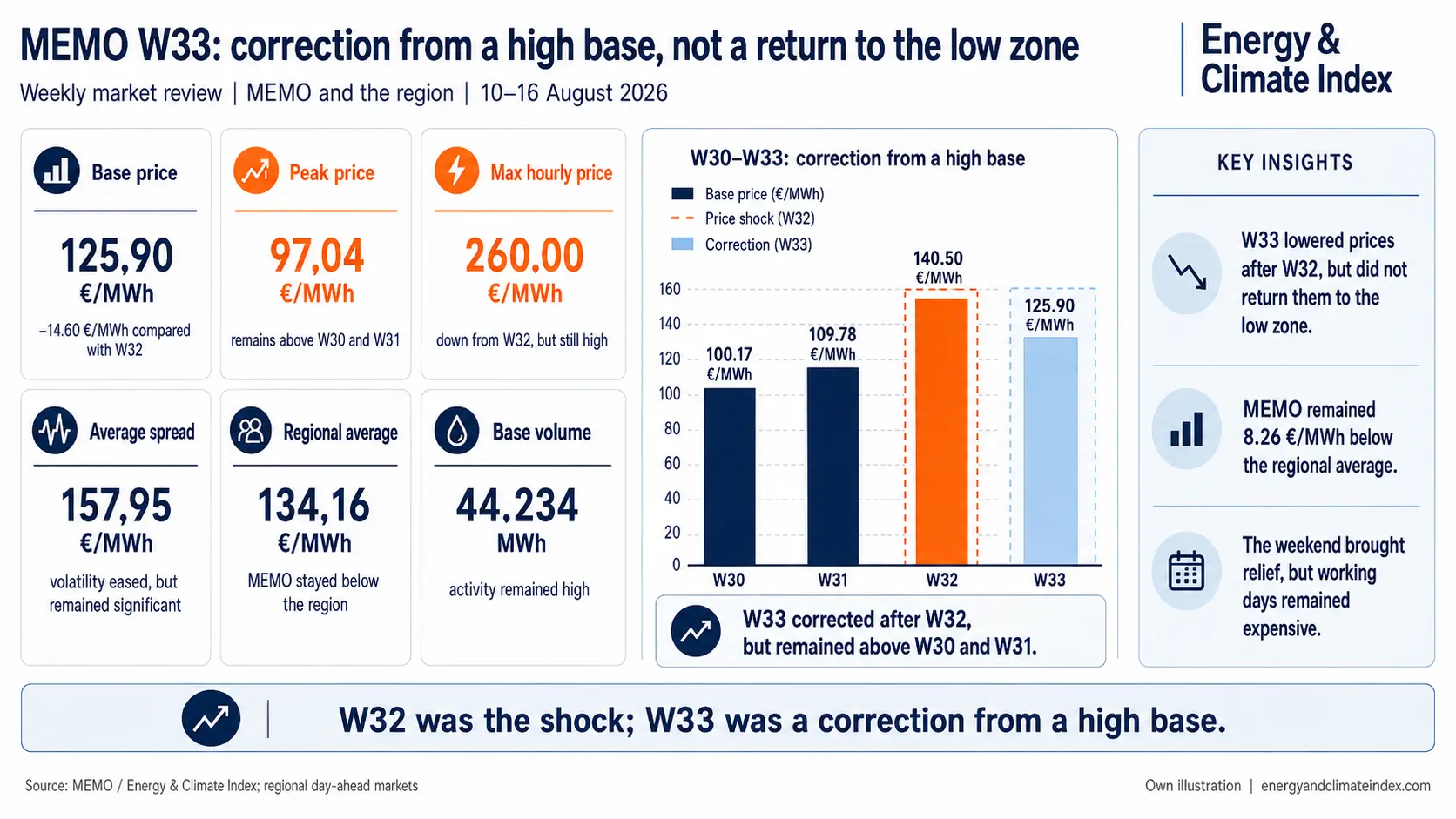
W33 brought some easing after the strong price shock in W32, but not a return to a low summer zone. MEMO ended the week with an average base price of 125.90 €/MWh and an average peak price of 97.04 €/MWh. This was a decline compared with W32, but still a high level for a summer market. The regional average of the nine monitored day-ahead markets fell to 134.16 €/MWh, with MEMO remaining around 8.26 €/MWh below the region.
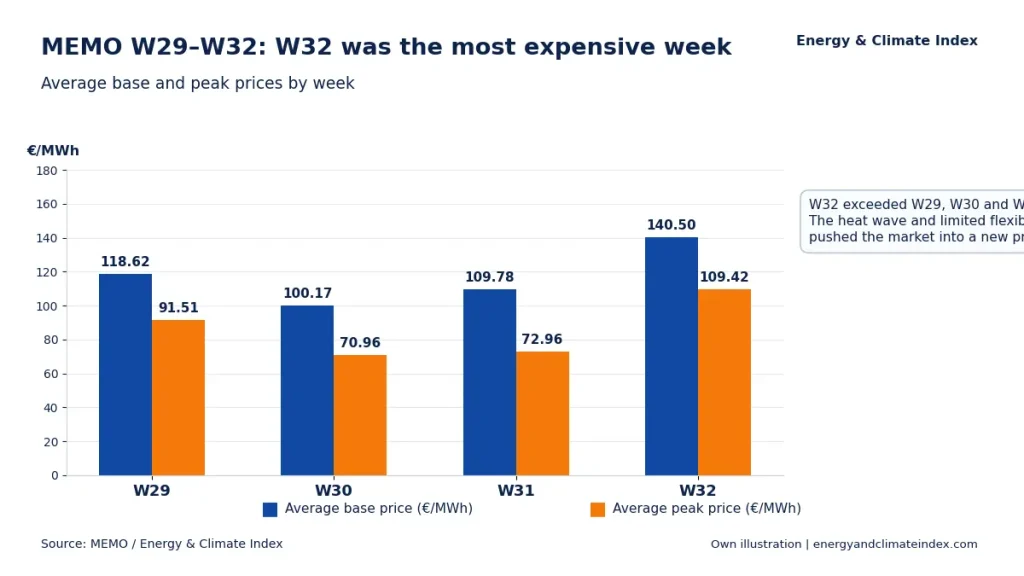
In W32, the main story was the price shock caused by heat and water-related pressure. In W33, the picture changed: the market corrected, but from a very high base. This is why the week should not be read as a stabilisation, but as a controlled easing of price pressure.
MEMO declined from W32, but remained high
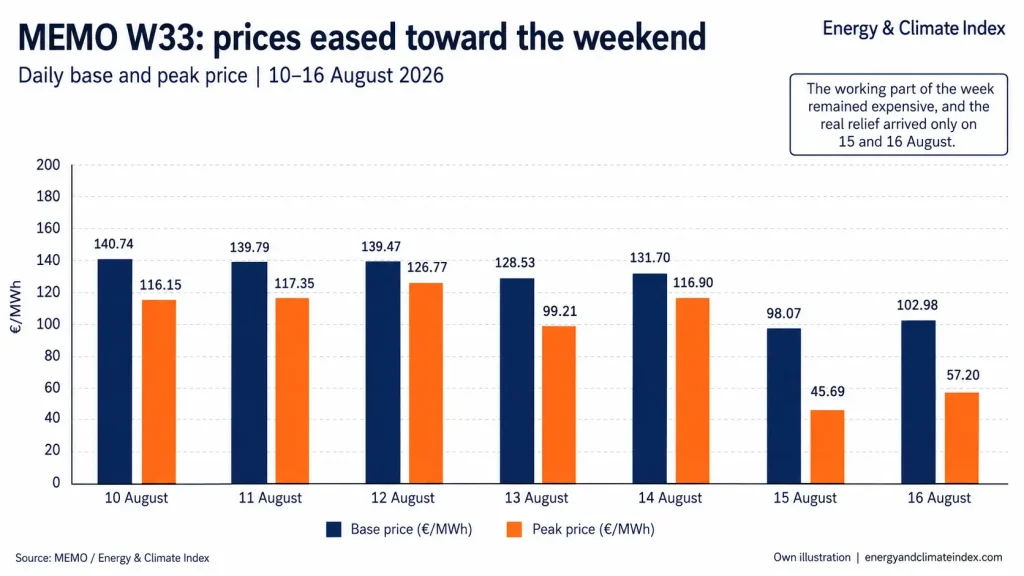
MEMO’s average base price fell from 140.50 €/MWh in W32 to 125.90 €/MWh in W33, a decrease of 14.60 €/MWh. The peak price declined from 109.42 €/MWh to 97.04 €/MWh.


This was a clear correction, but not a return to the levels seen in W30 or W31. MEMO remained well above W31, when the base price stood at 109.78 €/MWh, showing that the market was still operating in a higher summer regime.
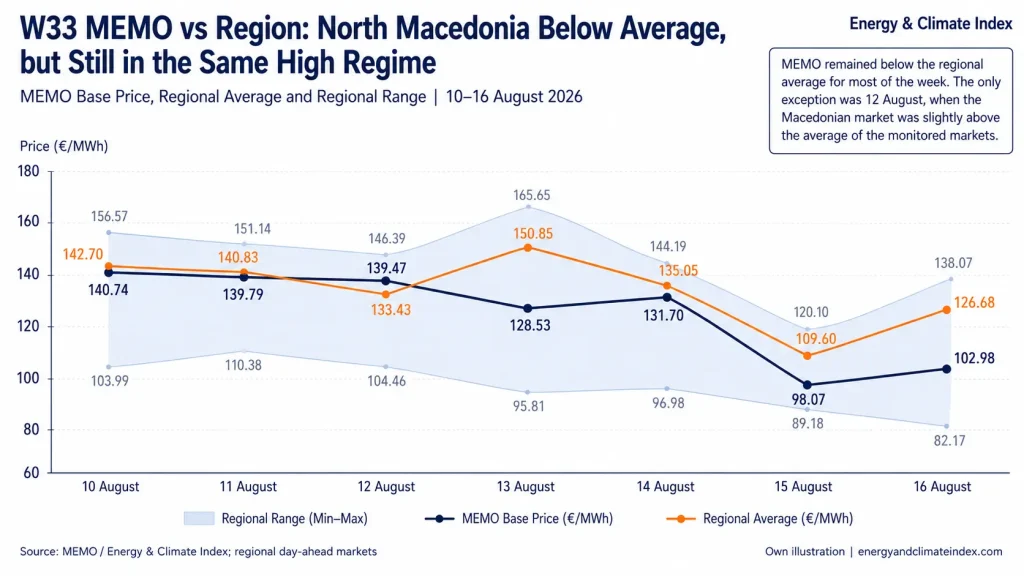
On a daily basis, the strongest pressure appeared at the start of the week. The base price was highest on 10 August, at 140.74 €/MWh, while the highest peak price was recorded on 12 August, at 126.77 €/MWh. The weekend brought more visible relief, with the base price falling below 105 €/MWh, but it did not erase the weekly signal.
Volatility eased, but remained relevant
The most important change in W33 was the decline in hourly volatility. The maximum hourly price fell from 308.07 €/MWh in W32 to 260.00 €/MWh, while the average spread declined from 195.54 €/MWh to 157.95 €/MWh.
But a spread of almost 158 €/MWh is still high. This means the market was not stable in the classic sense. It was simply less extreme than the previous week. The largest daily spread was recorded on 10 August, at 216.00 €/MWh, showing that the first day of the week still carried the inertia from W32.
The region cooled, but not evenly
The regional average fell from 147.04 €/MWh in W32 to 134.16 €/MWh in W33. This was a meaningful easing, but prices remained above MEMO and above levels that would indicate a full normalisation.
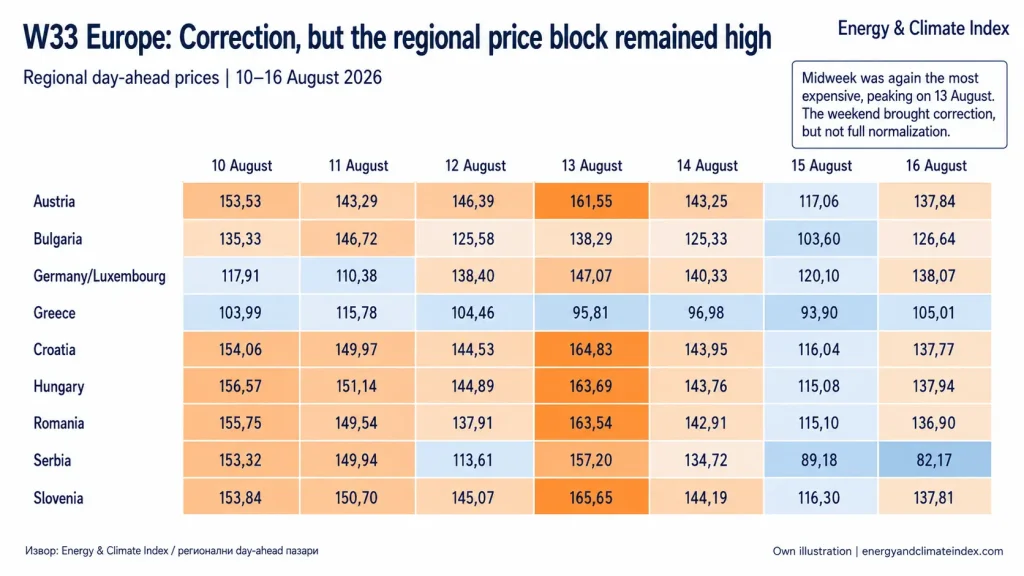
The strongest regional day was 13 August, when the average of the monitored markets reached 150.85 €/MWh. This shows that W33 was not a uniformly calm week: there was a clear mid-week peak, followed by a decline toward the weekend.
In the regional structure, the Central and Southeast European block remained above MEMO. Slovenia, Hungary, Croatia, Austria and Romania held the upper price zone, while Bulgaria was close to MEMO and continued to play an important role as a balancing and export market. Greece remained lower than the rest of the group, acting as a southern market with weaker price pressure compared with the Danube and Central European block.
MEMO remained below the region, but followed the same direction
In W33, MEMO was 8.26 €/MWh below the regional average. This means the Macedonian market was not in the upper part of the regional price zone, but it was not detached from the regional trend either.
The working part of the week was higher both for MEMO and for the region, while the weekend brought a correction. This synchronisation matters: MEMO moved with the region, but with a lower amplitude than the most pressured markets.
Volumes show that market activity remained high
Although prices fell, volumes remained close to W32 levels. Base volume stood at 44,234 MWh, only slightly below W32, while peak volume increased to 29,655 MWh.
This is an important signal: W33 was not a week of weak activity. The market remained liquid, and the price correction took place with trading volumes still high. That makes the weekly signal more significant: this was not a statistical decline on a thin market, but a real easing in prices while market activity remained stable.
Conclusion
W33 brought a correction, but not normalisation. MEMO came down from the W32 extreme, but remained in a high summer zone, with a base price of 125.90 €/MWh and a peak price of 97.04 €/MWh. The regional average also declined, but remained above MEMO.
The key message is that W33 reduced the intensity of the price shock, but did not close the risk. The market continues to react to summer demand, limited flexibility and regional differences in generation availability. W32 was the shock; W33 was the correction from a high base.
ECI