

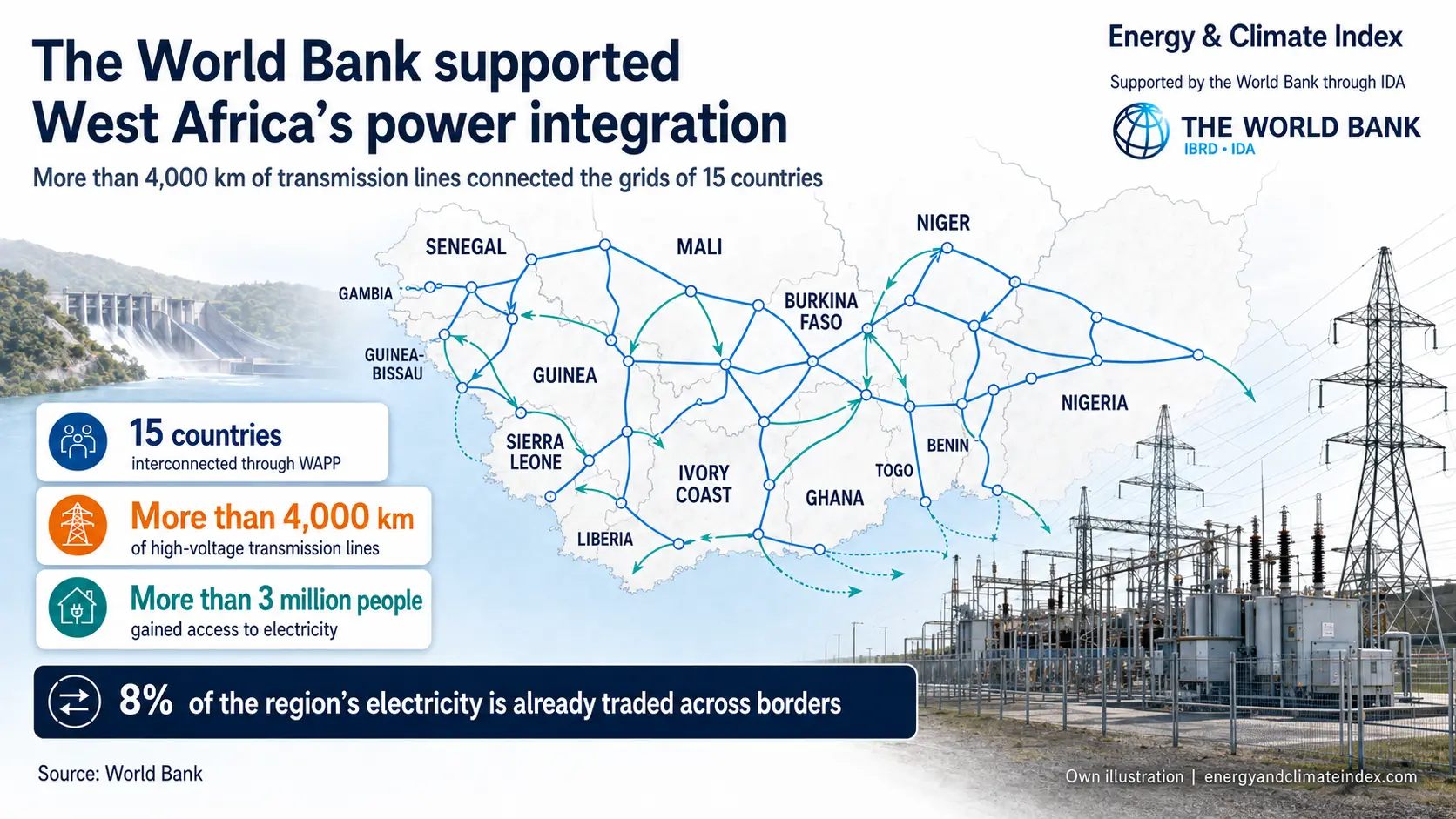
More than 4,000 kilometres of high-voltage transmission lines have connected the electricity systems of 15 West African countries, creating the foundation for stronger cross-border trade, lower costs and a more reliable power supply.
The World Bank supported the programme through the International Development Association – IDA, with co-financing from several international financial institutions. The World Bank supported the development of cross-border interconnectors, the expansion of distribution networks, last-mile electricity connections and the establishment of a regional electricity market.
According to the World Bank, approximately 8% of the region’s electricity is now traded across borders through the West African Power Pool – WAPP. This is already approaching the European Commission’s benchmark of 10–12% for cross-border electricity trade.


The regional power integration and electricity access programme connects national grids, enables more efficient use of available generation capacity and helps countries facing shortages import electricity from neighbouring systems.
More than three million people gained access to electricity
Between 2019 and 2025, more than three million people in Burkina Faso, Guinea, Liberia, Senegal, Sierra Leone and The Gambia benefited from electricity services following investments in transmission and distribution networks.
Several major cross-border interconnections were developed, including the line linking Côte d’Ivoire, Liberia, Sierra Leone and Guinea; the transmission loop connecting Guinea, Guinea-Bissau, The Gambia and Senegal; and the interconnector between Senegal and Mali.
Technology integrated into the new transmission lines also enabled the electrification of nearby communities. As new substations became operational, last-mile connections to households and businesses were expanded.
Hydropower imports reduced generation costs
Regional integration has delivered significant financial benefits for several national electricity utilities.
Guinea-Bissau and The Gambia began importing electricity generated by Guinea’s large hydropower plants. As a result, the generation costs of Guinea-Bissau’s utility EAGB fell by more than half, from 25 to 11 US cents per kilowatt-hour. The company moved from a monthly deficit of approximately $1 million to a positive financial balance.
In The Gambia, the costs of national utility NAWEC declined by around 42%, helping the company return to profitability.
Liberia and Sierra Leone, meanwhile, gained access to lower-cost electricity from Côte d’Ivoire, reducing their generation costs by 10–20%.
Regional day-ahead market under development
The next phase involves launching a regional day-ahead electricity market. It will allow utilities to purchase electricity for the following day, optimise costs and reduce the risk of supply interruptions.
In late 2025, regulators validated the tariffs for the new market, while WAPP completed its first synchronisation trial with uninterrupted electricity flows across 12 West African countries.
A liquidity-enhancement revolving fund is also planned to improve payment security and strengthen confidence in regional electricity trading. At the same time, reforms of national utilities and preparations for additional cross-border interconnectors are expected to continue.
More than 52,000 jobs created
According to the World Bank, the construction and operation of the regional transmission networks created more than 52,000 direct and indirect jobs. These covered engineering, construction, logistics, project management, operations and maintenance.
The programme demonstrates how cross-border integration can offer a more cost-effective response to electricity shortages than relying exclusively on separate national investments in expensive generation capacity. The regional network also supports more efficient use of hydropower resources, reduces dependence on imported liquid fuels and expands access to electricity.
ECI