

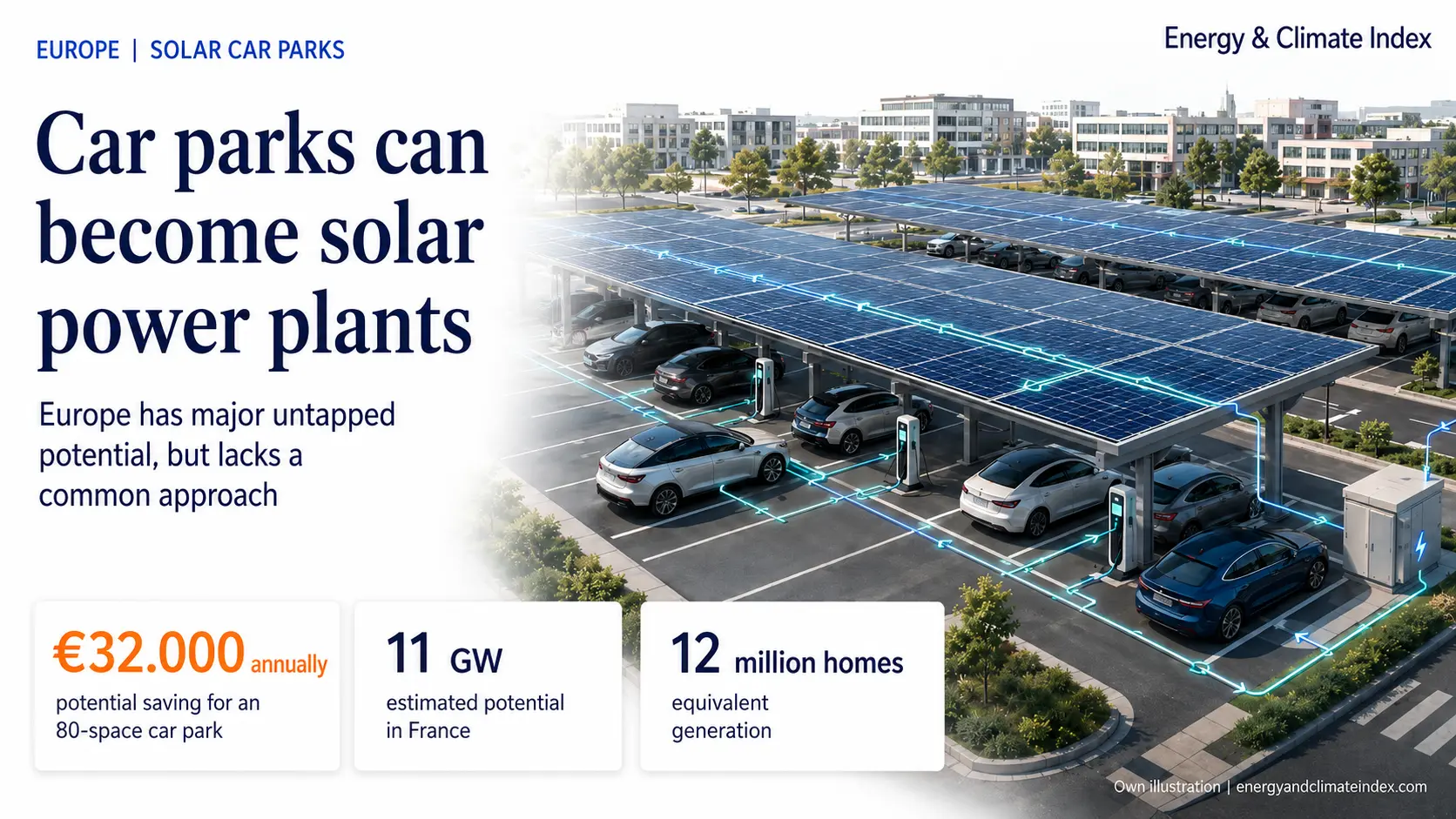
Covering car parks with photovoltaic panels could simultaneously generate electricity, provide charging infrastructure for electric vehicles and reduce the need to use additional land for solar projects.
However, European countries are pursuing very different policies, from mandatory requirements in France and Slovenia to the United Kingdom’s decision to abandon a compulsory model.
According to initial estimates by the UK government, an 80-space car park could save around £28,000, or approximately €32,000, per year if all the electricity generated were used on site. Additional revenue could also be earned by selling surplus electricity to the grid.


Electricity generation without using additional land
Solar carports enable electricity generation above existing infrastructure. This avoids some of the challenges associated with large photovoltaic power plants, including land use, biodiversity impacts and lengthy spatial-planning procedures.
The same structures can also accommodate electric vehicle chargers, while providing shade and helping to reduce vehicle cabin temperatures during the summer.
The falling cost of solar energy further strengthens the economic case for such projects. According to data cited by Euronews, electricity generated by photovoltaic panels was, on average, 41% cheaper than the lowest-cost fossil fuel alternatives in 2024.
France estimates potential at 11 GW
France has adopted the most ambitious approach to solar car parks. Legislation approved in 2022 required existing and new car parks with at least 80 spaces to be covered with photovoltaic panels.
Car parks with more than 400 spaces were given until 2025 to comply, while facilities with between 80 and 400 spaces have until 2027. At least half of the surface area of larger car parks must be covered.
The French government initially estimated that the measure could add 11 GW of photovoltaic capacity – enough electricity generation to supply around 12 million households. Operators that failed to comply faced annual fines of up to €40,000.
The rules were later relaxed. Outdoor car parks covering more than 1,500 square metres can now meet part of the requirement by planting shade-providing trees or by using a combination of trees and photovoltaic panels.
Slovenia and German states introduce requirements
Slovenia has adopted a similar approach. New and reconstructed car parks larger than 1,000 square metres are required to install photovoltaic panels.
Germany does not have a single federal rule, but several states, including Baden-Württemberg, North Rhine-Westphalia, Schleswig-Holstein, Rhineland-Palatinate and Lower Saxony have introduced their own requirements for new car parks.
United Kingdom abandons mandatory model
In 2025, the UK government launched a consultation on how to harness the solar potential of car parks. However, after reviewing the available evidence and engaging with industry representatives, it decided not to make solar canopies mandatory for new car parks.
The government said solar energy remains central to its energy policy, but that these projects would continue to be supported through standards for new buildings and market-based mechanisms.
The solar industry described the decision as a missed opportunity, warning that market conditions alone are often insufficient to accelerate the development of such investments.
Leeds project generates 852 MWh annually
A practical example is the solar park-and-ride carport in Leeds. The system is expected to generate around 852,000 kWh of electricity annually and avoid 471 tonnes of carbon emissions – an impact equivalent to removing 203 cars from the road.
The project can also store surplus electricity generated during the day, enabling it to provide lower-cost electricity for vehicle charging. The estimated payback period for the charging infrastructure is less than ten years.
ECI