

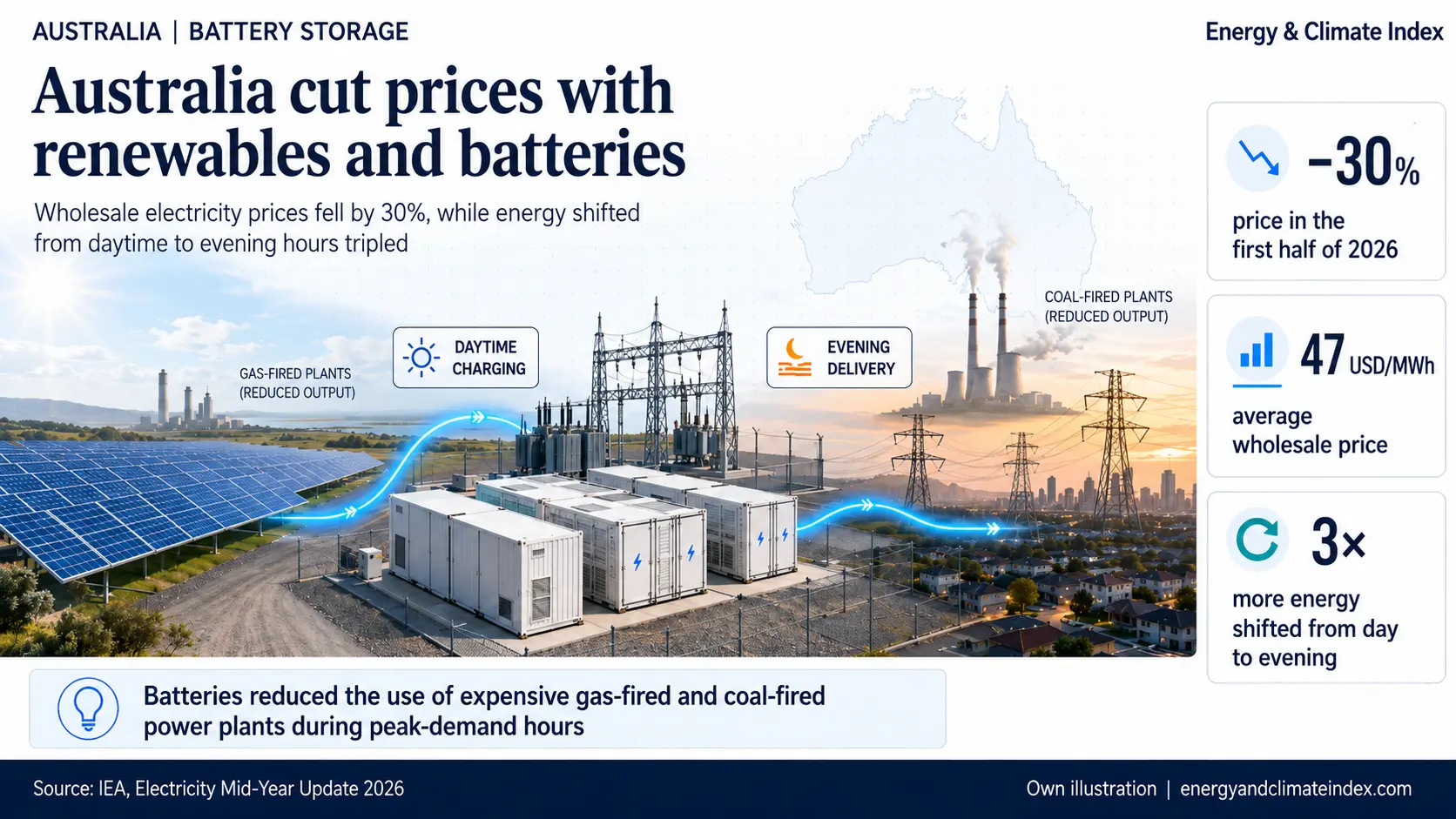
The average wholesale electricity price in Australia’s National Electricity Market (NEM) fell by 30% year-on-year in the first half of 2026, reaching USD 47 per megawatt-hour.
According to the International Energy Agency’s Electricity Mid-Year Update 2026, the decline was supported by strong renewable electricity generation and rapidly expanding battery storage capacity. In the second quarter of 2026 alone, Australia’s average wholesale electricity price was around 45% lower than in the same period a year earlier.
The results show that battery storage is beginning to have a direct impact on electricity market operations. Newly installed battery capacity contributed to a threefold increase in the amount of electricity shifted from daytime to evening hours in the first quarter of 2026.


Batteries charge during the day, when solar generation is high and electricity prices are low. The stored electricity is then delivered to the grid during the evening, when solar output declines while demand remains elevated.
By shifting electricity between different periods of the day, Australia reduced the need to dispatch more expensive gas- and coal-fired power plants during high-demand hours. This helped mitigate price surges and lower the average wholesale electricity price.
Lower exposure to the global gas price shock
Australia’s electricity market remains exposed to movements in global natural gas prices. However, gas-fired power plants set the marginal electricity price during fewer hours than in some European and Asian markets.
As a result, the increase in global gas prices had a considerably smaller impact on Australian electricity prices. According to the IEA, electricity futures for Australia’s NEM increased by around USD 25/MWh from pre-crisis levels following the gas supply shock.
For comparison, the increase reached almost USD 60/MWh in Italy, around USD 40/MWh in the United Kingdom and approximately USD 30/MWh in Germany.
Market expectations for the second half of 2026 point to a further decline of around 5% in Australian wholesale electricity prices compared with the same period in 2025.
Negative prices remain a challenge
Despite the decline in the average price, the Australian market continues to experience significant differences between daytime and evening prices.
South Australia and Victoria recorded the highest shares of negative electricity prices among the markets analysed by the IEA. During the first half of 2026, wholesale prices fell below zero in more than 20% of all hours.
In South Australia, however, the number of negative-price hours did not increase compared with 2025. The IEA links this stabilisation to the region’s rapidly expanding battery capacity, which absorbs part of the surplus electricity produced during periods of strong solar generation.
At the same time, South Australia recorded several instances of prices exceeding AUD 5,000/MWh in the first quarter. These spikes occurred during periods of tight supply-demand conditions and electricity network constraints.
Batteries are becoming a major market factor
Australia’s experience shows that battery storage can simultaneously increase the value of solar generation, reduce the use of more expensive fossil-fuel power plants and mitigate evening price peaks.
The results also demonstrate that batteries alone cannot eliminate every constraint in the electricity system. The high share of negative-price hours and the occurrence of extreme price spikes indicate that parallel investment is needed in electricity networks, new transmission capacity and additional sources of flexibility.
Nevertheless, Australia provides concrete evidence that batteries are already having a measurable market impact. Electricity produced during low-cost daytime hours is being shifted to periods of higher demand, reducing both average wholesale prices and dependence on expensive fossil-fuel generation.
ECI