

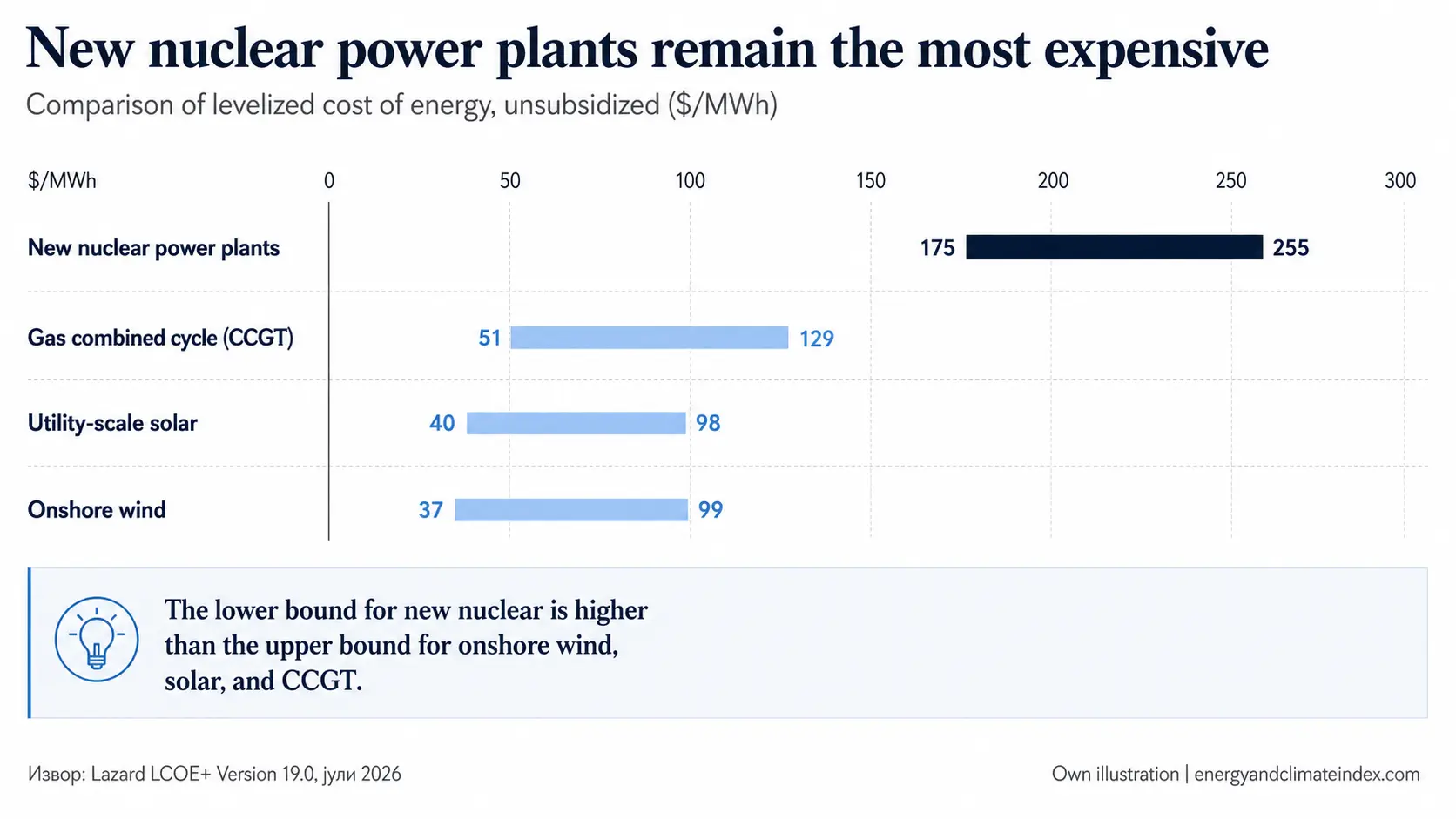
Lazard 2026: Onshore wind and utility-scale solar continue to have the lowest levelized cost of energy, while new nuclear capacity remains by far the most expensive technology to build in USA
Renewable energy sources remain the most competitive option for new power generation capacity in 2026, according to Lazard’s latest Levelized Cost of Energy+ Version 19.0 analysis. Although all technologies are facing higher capital costs, inflation and elevated interest rates, onshore wind and utility-scale solar still have the lowest levelized cost of energy (LCOE), while new nuclear power plants remain the most expensive investment.
The analysis is based on the U.S. market and uses assumptions for costs, financing and tax policy specific to the United States. However, the report is widely regarded as one of the world’s leading benchmarks for comparing the economic competitiveness of different power generation technologies.


Wind and solar remain the cheapest new sources of electricity
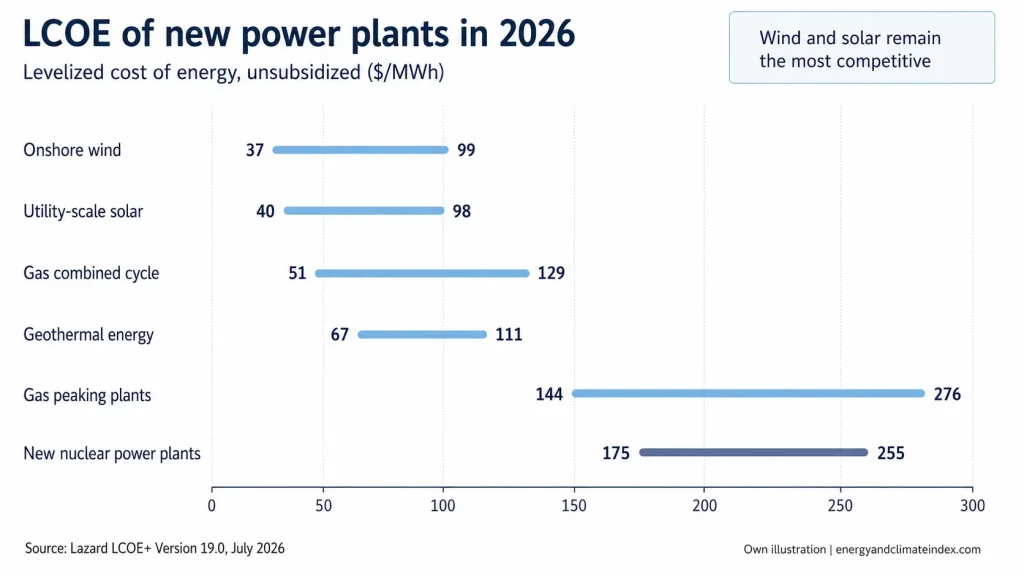
According to the analysis, onshore wind power has an LCOE of $37–99/MWh, while the levelized cost of utility-scale solar ranges from $40 to $98/MWh.
This year’s edition also includes geothermal energy for the first time, with an estimated LCOE of $67–111/MWh, positioning it as an increasingly relevant low-carbon technology for continuous power generation.
Combined-cycle gas remains the most competitive dispatchable source
Among conventional technologies, combined-cycle gas turbines (CCGTs) have the lowest costs, with an LCOE ranging from $51 to $129/MWh.
However, Lazard warns that constrained gas turbine supply, higher capital costs and longer delivery timelines are increasing the cost of new gas-fired projects. Gas peaking plants have a significantly higher LCOE, ranging from $144 to $276/MWh.
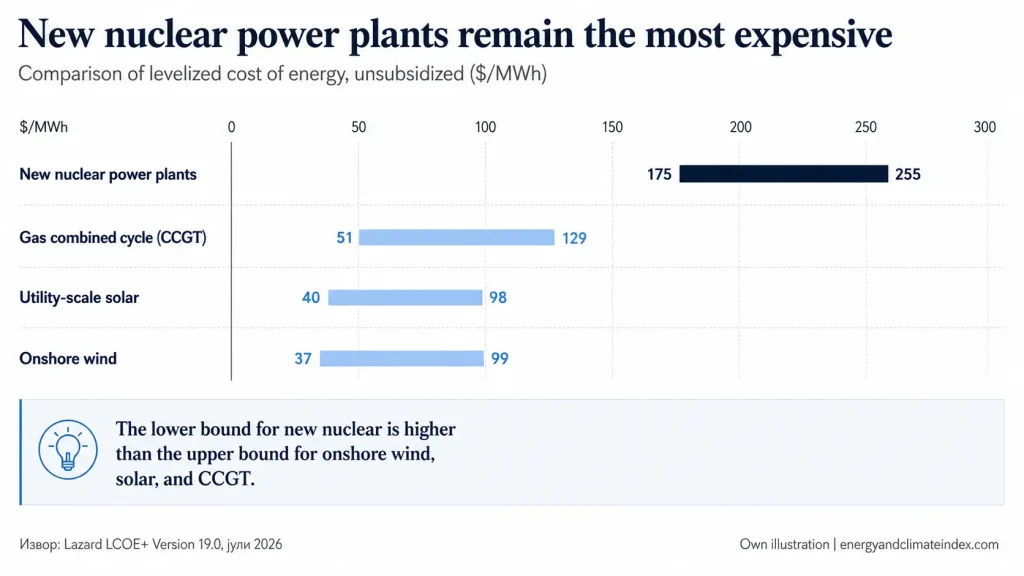
New nuclear power plants remain the most expensive technology
New nuclear power plants continue to have the highest investment costs.
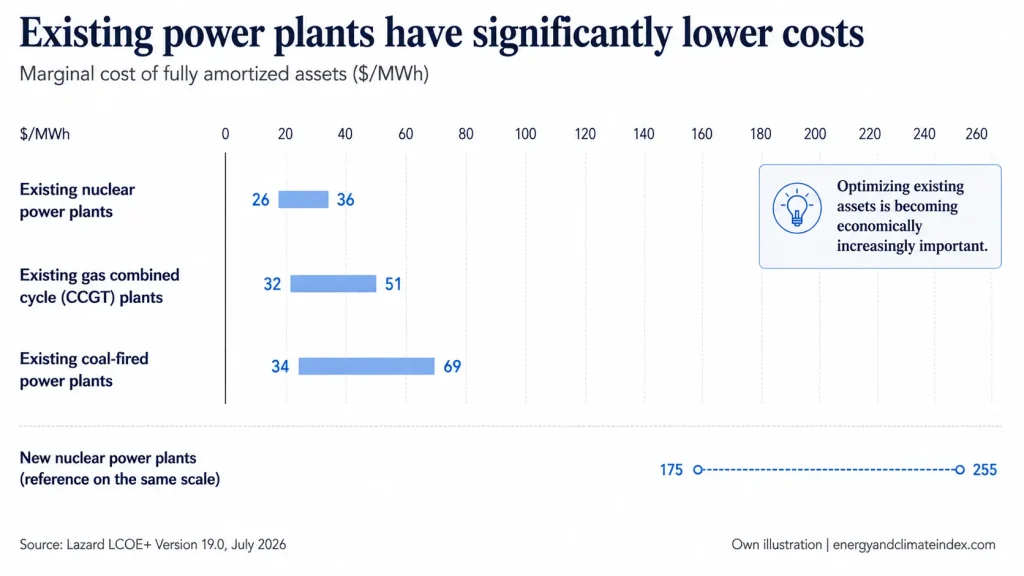
According to Lazard, the LCOE of new nuclear projects reaches $175–255/MWh, several times higher than the cost of wind and solar generation.
The estimate is based on the latest available data from the U.S. Vogtle Units 3 and 4 project, which represents the most relevant recent example of newly completed nuclear capacity in the United States.
The cost of capital is becoming increasingly important
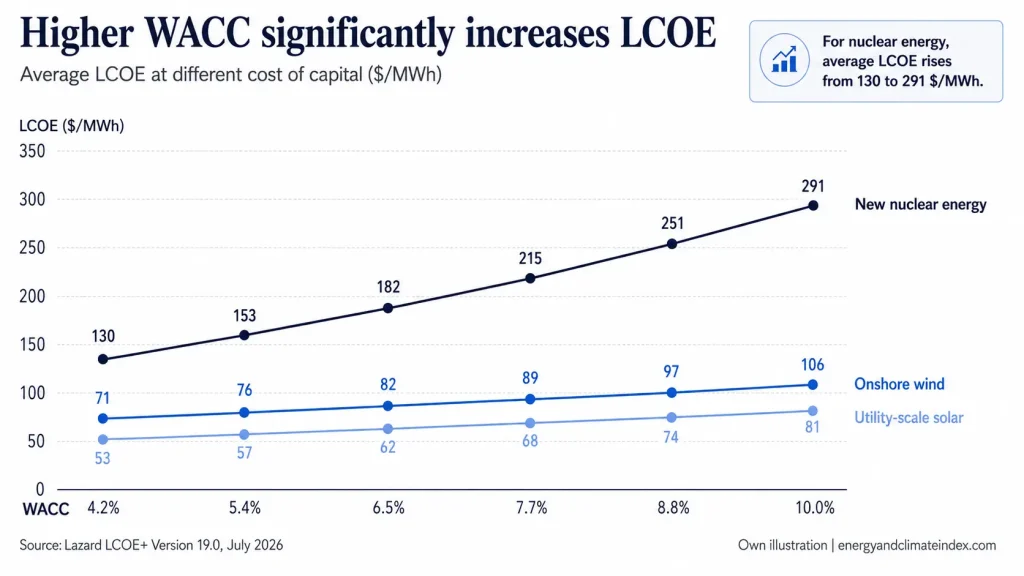
Lazard identifies the impact of the cost of capital (WACC) on the economics of new investments as one of the most important developments in 2026.
Higher interest rates have an especially strong impact on capital-intensive technologies such as nuclear power and offshore wind, while solar and onshore wind projects are also recording higher LCOEs compared with previous years.
Existing power plants are gaining economic value
The report shows that rising new-build costs are increasing the economic value of existing generation assets.
The marginal operating cost of existing nuclear plants ranges from $26 to $36/MWh, compared with $32–51/MWh for existing combined-cycle gas plants and $34–69/MWh for existing coal-fired power stations. According to Lazard, this helps explain the growing interest in extending plant lifetimes and restarting previously closed nuclear capacity.
ECI