

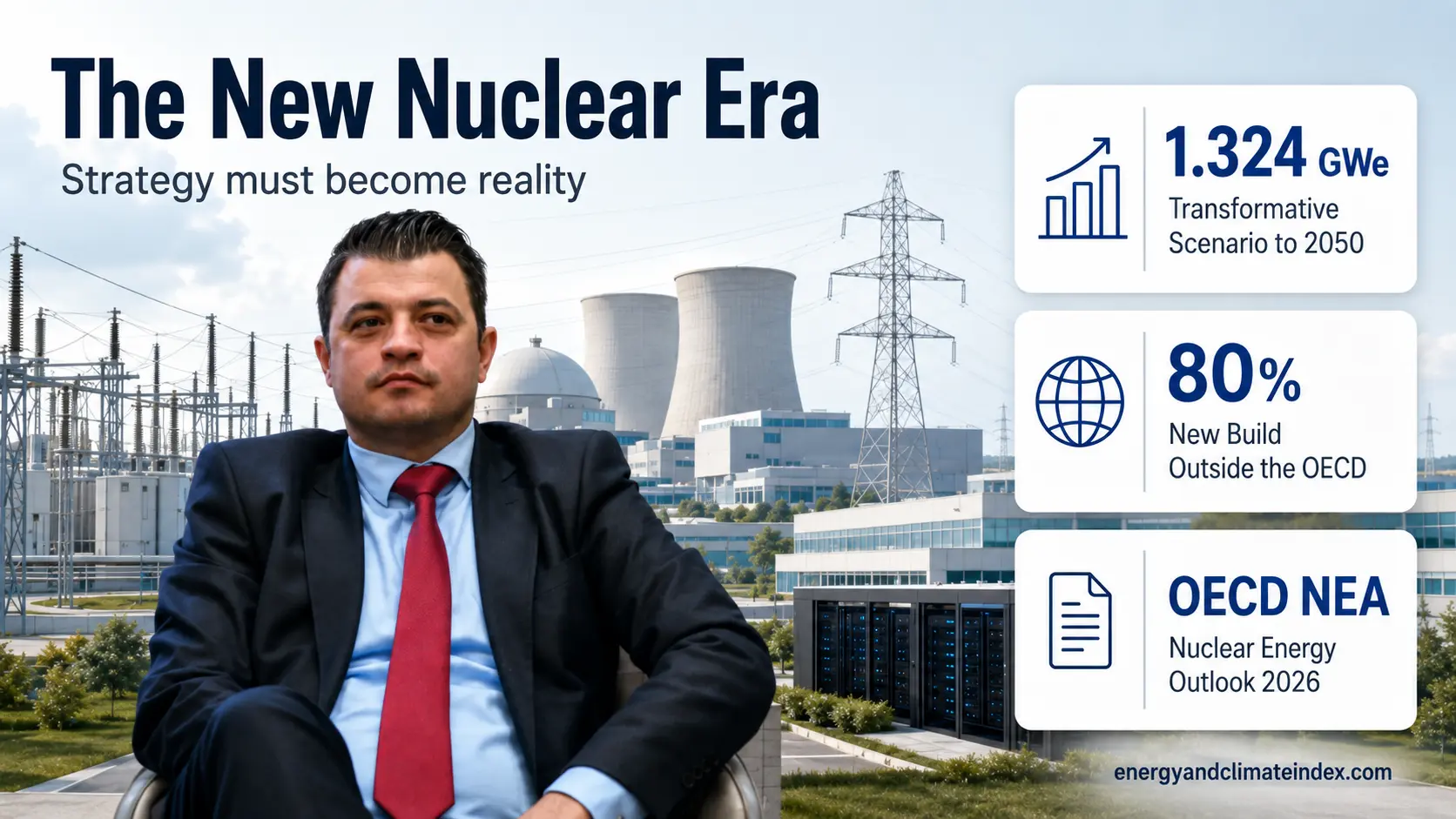
In energy, there are moments when a technology stops being just a technical issue and becomes a matter of state power. Nuclear energy is once again at exactly such a moment.
After three decades in which much of the developed world debated more than it built, nuclear energy is returning to the center of global energy strategy. But this return is not nostalgia for old large-scale power plants, nor a romantic idea of “baseload energy” from the previous century. It is a response to a new reality: energy insecurity, industrial competition, accelerated electrification, the rise of artificial intelligence and the need for stable low-carbon power.
The new Nuclear Energy Outlook by the OECD Nuclear Energy Agency – NEA detects precisely this dilemma. The world could more than triple nuclear capacity by 2050.

But this will not happen through declarations, conference messages or political statements. It will happen only if countries once again learn how to build complex industrial infrastructure.
This is the core issue: the nuclear era will not be led by those who support it most loudly, but by those who can deliver reactors, fuel, engineers, licences, financing models and megawatts.
Nuclear energy is once again becoming a question of sovereignty
For a long time, nuclear energy was viewed mainly through the lens of climate policy. Today, that is no longer enough. After the war in Ukraine and the energy shock in Europe, security of supply has once again become as important as emissions.
Nuclear energy has one strategic advantage that is gaining weight again: it produces large amounts of electricity with limited dependence on continuous fuel imports. Unlike gas systems, which often depend on continuous import routes, pipelines, terminals and unstable geopolitical relations, nuclear energy offers a different type of energy security: small volumes of fuel, long operating cycles and the ability to plan supply strategically.
Coal, on the other hand, historically provided a certain degree of energy autonomy in countries with domestic reserves. But today, it is increasingly losing that role because of climate policies, emissions costs and the constraints imposed by the energy transition.
That is why nuclear energy is returning as a mater of national security. Not as a replacement for renewables, but as their strategic partner. In a system with a high share of solar and wind, the question is no longer only how cheaply electricity can be produced in an ideal hour. The question is how much the system costs when it has to operate every hour, every day, in every season.
This is where nuclear energy comes back into the game. Not as a perfect solution without risks, but as stable low-carbon capacity that can reduce total system costs, strengthen security of supply and support industry in a period of mass electrification.
The East is building, while the West is trying to return
The nuclear revival, however, is not happening symmetrically. This is where the most important geopolitical message from the NEA report lies.
Although OECD countries still hold the largest share of existing global nuclear capacity, new construction is increasingly shifting outside the OECD. China is building at a pace that allows it to create a domestic industrial base, technological experience and future export capacity.
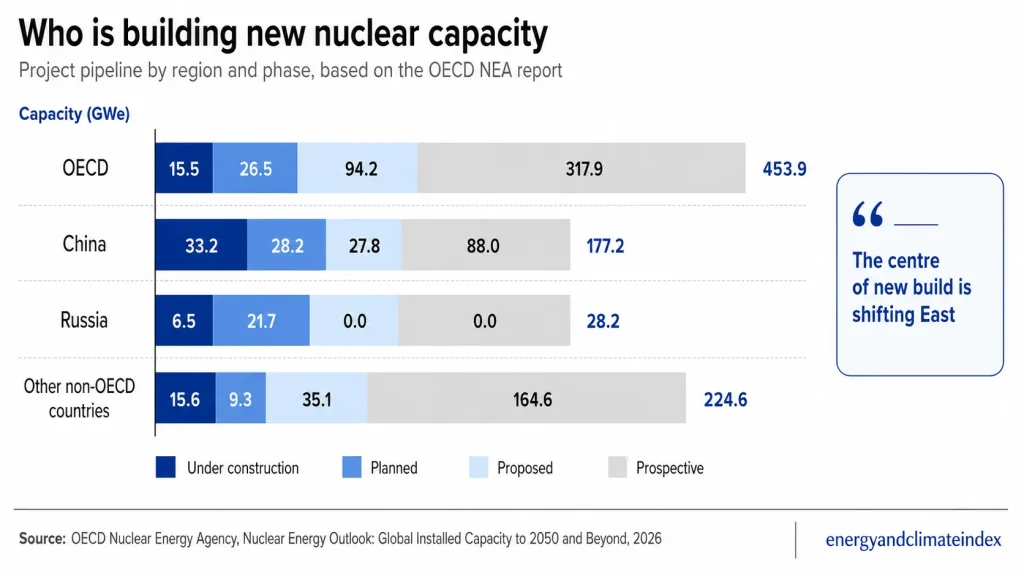
Russia, meanwhile, uses nuclear energy as a complete geopolitical package: reactor technology, financing, fuel, training, maintenance and a long-term operational relationship.
That is the key difference. In the nuclear sector, what is being sold is not only technology. What is being sold is a long-term relationship.
When a country chooses a nuclear supplier, it is not simply buying a power plant. It is entering into a technological, regulatory, financial and political relationship that can last 60, 80 or even more years.
Fuel, spare parts, modernisations, safety standards, workforce training and future upgrades tie the client country to the supplier country much more deeply than in most other energy technologies.
That is why nuclear energy is once again becoming an instrument of geopolitical influence. Countries that can offer a complete ecosystem will have an advantage over those that only have a good project on paper.
The West’s problem is not technology, but execution
OECD member states have knowledge. They have regulators. They have an engineering tradition. They have companies with decades of experience. But their problem is that, for much of the past 25 to 30 years, they did not have a continuous cycle of new construction.
And when an industry does not build for a long time, it does not lose only political confidence. It loses suppliers, workers, project routines, financial discipline and institutional memory.
That is the fundamental problem. Nuclear energy does not return through a single government announcement. It returns through factories, certified components, trained welders, engineers, project managers, regulators and banks willing to finance long-term projects with high capital risk.
That is why the most important change the West needs to make is the shift from individual projects to programme-based delivery. The model of “one project, one site, one design, one regulatory battle” is a recipe for delays and cost overruns.
The nuclear industry becomes competitive when it builds in series, uses standardised designs, creates continuity of work and gives suppliers confidence that they are not investing for only one reactor.
In energy, industrial confidence is not built through ambition, but through repetition. The first project is expensive, the second is a lesson, the third begins to create an industry. Without series, there is no economy of scale. Without economy of scale, there is no competitiveness.
LTO is the bridge that must not collapse
While the world is looking toward new reactors, the first practical battle is around the existing ones. Extending the lifetime of current nuclear power plants – LTO may not sound like the most exciting part of the nuclear cycle, but it is one of the most important.
The reason is simple. If existing reactors are closed faster than new ones are built, the nuclear cycle will look good only on a chart, but it will not deliver real capacity growth.
LTO is an energy bridge. It preserves existing low-carbon capacity, maintains grid stability and buys time for the next generation of reactors. In countries with an ageing nuclear fleet, it is probably the cheapest and fastest way to preserve stable clean energy.
But LTO requires decisions. It cannot be postponed indefinitely. Licensing, modernisation, safety investments and workforce planning must be done on time.
Otherwise, countries will find themselves in a paradox: they will talk about nuclear expansion while at the same time losing existing reactors that already produce stable low-carbon electricity.
SMR is a promise, but not a magic solution
Small modular reactors – SMRs carry the greatest political and commercial excitement in the nuclear sector. And for good reason. They promise a more flexible model, smaller units, factory-based production and the possibility for nuclear energy to enter new markets: data centers, industrial steam, replacement of coal-fired power plants, mining, district heating and isolated systems.
But this is precisely where moderation is needed. SMR technology does not eliminate the fundamental questions of the nuclear sector. It only transfers them into a new form.
Licences are needed. Factories are needed. Standards are needed. Customers willing to sign long-term contracts are needed. Banks that believe the first series will not become a financial experiment are needed. And, perhaps most importantly, a secure fuel supply chain is needed.
HALEU fuel is one of the most critical tests: low-enriched uranium with a higher level of enrichment, usually between 5% and 20%. If a large share of advanced SMR designs depend on fuel for which the OECD does not yet have a sufficiently developed commercial supply chain, then the risk is clear: the world may try to reduce fossil dependence, only to create a new nuclear dependence in the fuel cycle.
This does not mean that SMRs should be dismissed. On the contrary. But it does mean they should be treated as an industrial strategy, not as a marketing shortcut.
Big Tech is changing nuclear economics
In the past, nuclear projects were mainly a matter for states and large electric utilities. Today, new buyers are entering the picture with a different logic: technology giants.
Artificial intelligence and data centres require enormous amounts of electricity. And not only cheap electricity when there is sun or wind, but stable power 24 hours a day. That is why Microsoft, Google, Amazon and Meta do not see nuclear energy only as part of a climate agenda, but as infrastructure for their own growth.
This could change the financial structure of the sector. If large industrial and technology consumers are willing to sign long-term power purchase agreements, nuclear projects gain a new source of predictable revenue. This may reduce dependence on traditional state models, but it does not eliminate the need for a state role.
Nuclear energy is too complex, too regulated and too capital-intensive for the state to be merely an observer. Private capital can enter, but only if risks are clearly allocated, revenues are predictable and the regulatory pathway is credible.
The big number is not 2050, but today’s industrial capacity
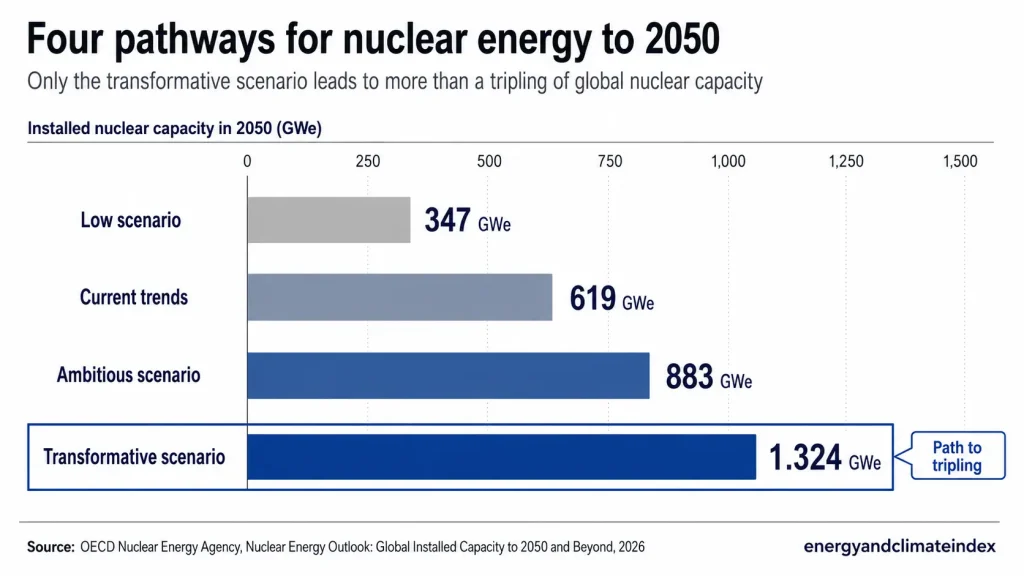
The NEA report contains scenarios through 2050. And they matter. The low scenario shows a world in which existing reactors are retired and new projects are not enough. The current trends scenario shows growth, but mainly driven by countries outside the OECD. The ambitious scenario shows acceleration. The transformative scenario, with around 1,324 GWe by 2050, is the only one aligned with the goal of tripling nuclear capacity.
But the real number is not 2050. The real number is how many reactors can be built at the same time, how many engineers are available, how many factories can deliver components, how many regulators can process licences and how much capital can be mobilised without turning every project into a financial drama.
That is the new energy compass: what matters is not only ambition, but the ability to execute.
Nuclear energy is a test of how serious states really are
In the 21st century, nuclear energy is no longer only a question of the electricity mix. It is a test of which states have industrial depth, financial discipline, regulatory maturity and a long-term strategy.
For OECD countries, the message is uncomfortable but clear: the time for declarative support is over. If they want to restore competitiveness, they must rebuild the industrial base, extend the lifetime of existing reactors, build in series, secure fuel, train the workforce and create financing models that can survive both political and market cycles.
For countries considering nuclear energy, the message is even more important: choosing nuclear technology is not an ordinary procurement decision. It is a multi-decade strategic choice.
The nuclear revival will not be won by those who describe it most elegantly. It will be won by those who turn it into an industry.
And in the new energy order, this is exactly what will make the difference between states that depend on other people’s systems and states that can shape their own energy future.
Viktor Andonov, M.Sc