

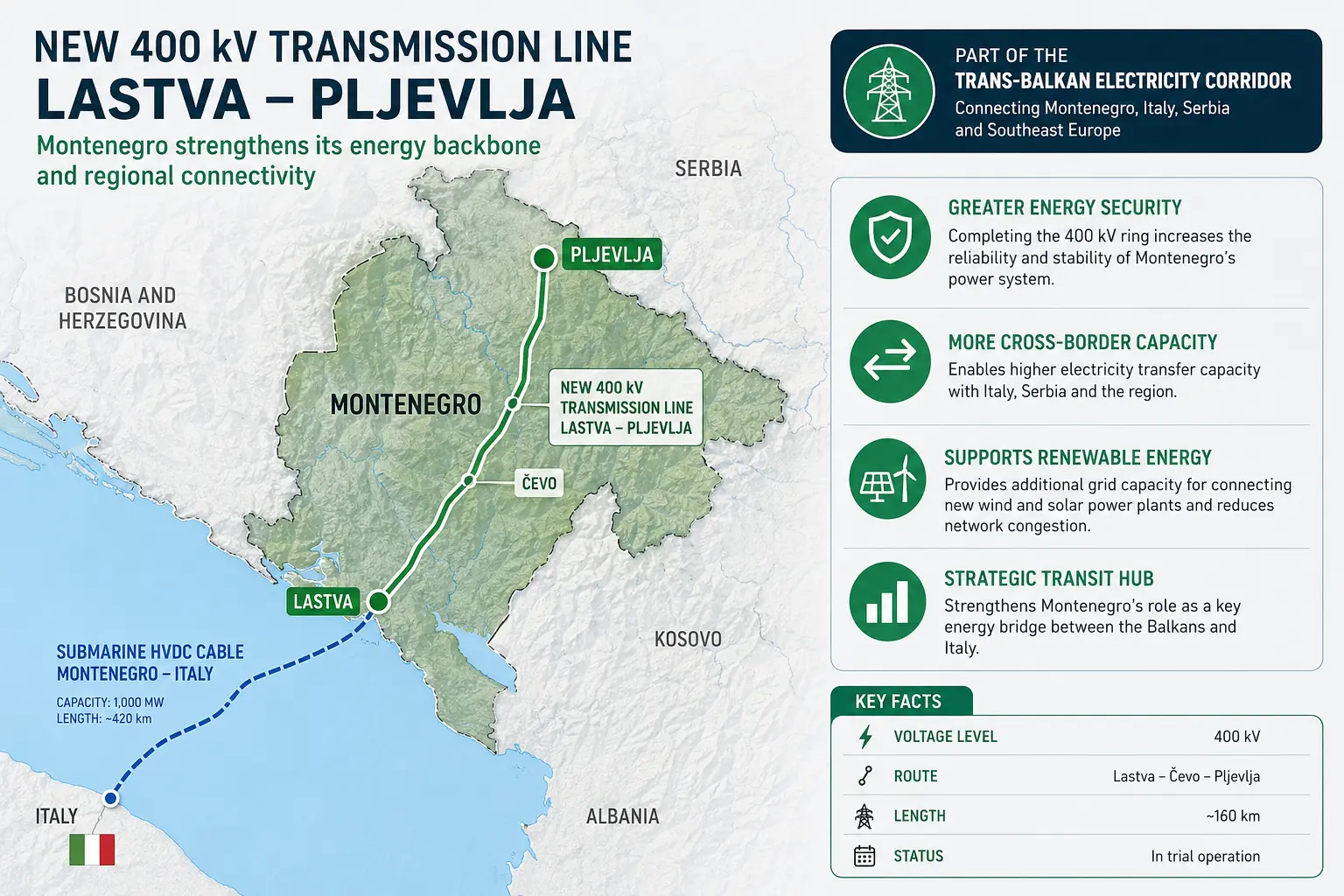
Montenegro’s transmission system operator, CGES, has placed the new 400 kV Lastva–Pljevlja transmission line into trial operation, marking a significant step towards completing the country’s high-voltage transmission network and further strengthening its role in the regional electricity market.
The project represents one of the key sections of the Trans-Balkan Electricity Corridor, connecting Montenegro with Italy through the submarine HVDC interconnector and, further on, with Serbia and the rest of Southeast Europe.
With this section entering trial operation, Montenegro has effectively completed its 400 kV transmission ring, improving system security, operational flexibility and cross-border electricity transfer capacity.


More than just a transmission line
Although the project is a conventional transmission infrastructure investment, its importance extends well beyond the power grid itself.
In recent years, countries across the region have significantly accelerated investments in wind and solar power. However, the successful integration of these renewable energy sources increasingly depends on the capacity and resilience of transmission networks.
The new 400 kV line creates additional room for connecting new renewable energy projects, reduces the risk of network congestion and enhances electricity exchanges between neighbouring markets.
At the same time, the project further strengthens Montenegro’s position as an important electricity transit hub between the Western Balkans and Italy, particularly following the commissioning of the 1,000 MW submarine interconnector.
What changes with the new transmission line
The commissioning of the Lastva–Pljevlja transmission line highlights a broader trend in the energy transition: future progress will increasingly depend on electricity networks, not only on building new generation capacity.
Expanding wind and solar deployment requires stronger transmission infrastructure, greater system flexibility and enhanced cross-border interconnections.
With this investment, Montenegro gains a more secure electricity system, higher transmission capacity and a stronger foundation for integrating additional renewable energy projects.
At the same time, the country reinforces its strategic role in connecting the electricity markets of the Western Balkans with Italy.
ECI