


In the first five months of 2026, 648.6 GWh of electricity were traded on North Macedonia’s day-ahead market, around 20% more than in the same period last year. At the same time, the weighted average price was around 20% lower. MEMO data point to a more liquid market, higher domestic coverage of consumption and a growing role for aggregators.
North Macedonia’s electricity market in the first five months of 2026 shows a clear shift compared with the same period in 2025: more electricity is being traded, but at a lower average price.
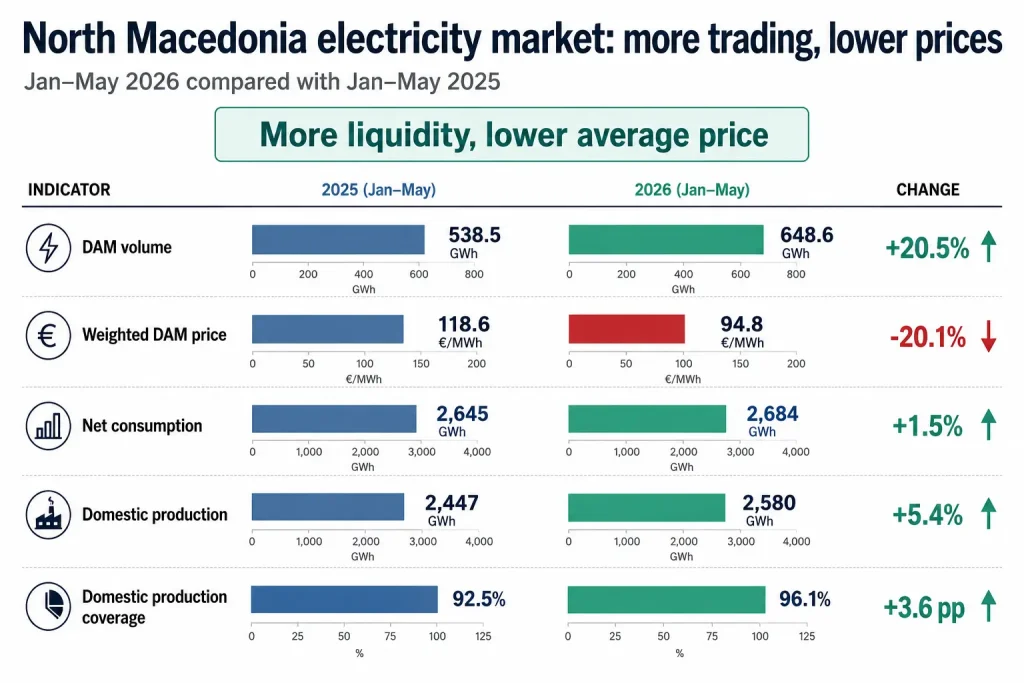
On the day-ahead market, traded volume increased from 538.5 GWh in January–May 2025 to 648.6 GWh in the same period of 2026. That represents growth of around 20.5%. At the same time, the weighted average price declined from 118.6 €/MWh to 94.8 €/MWh.


More liquidity on the exchange
The key point is that higher trading volumes did not come with higher prices. On the contrary, in 2026 North Macedonia’s day-ahead market recorded both higher volume and a lower weighted average price.
This indicates a deeper market, stronger participant activity and a greater role for organised electricity trading.
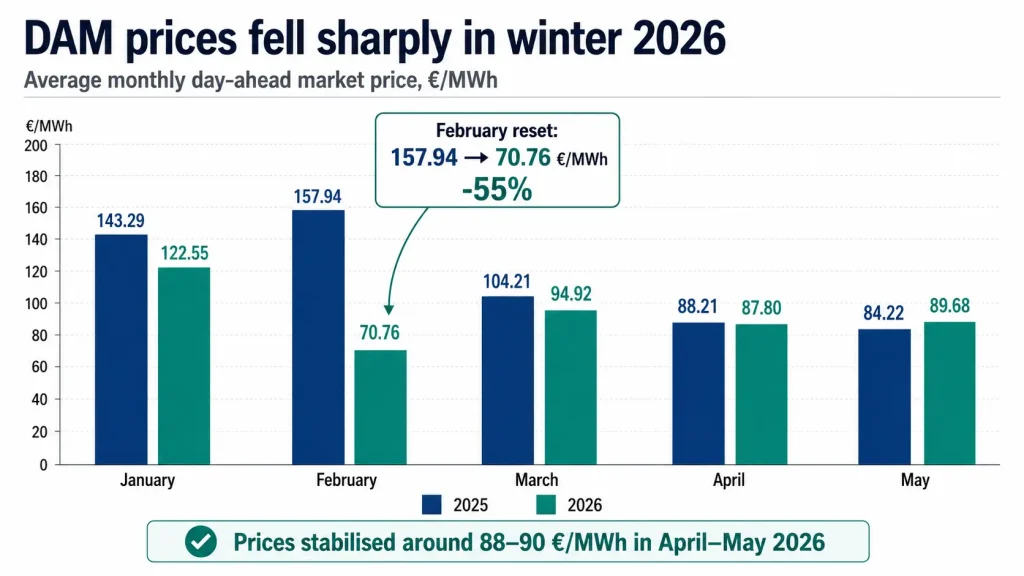
The difference is most visible in the winter months. In February 2025, the average DAM price was 157.94 €/MWh, while in February 2026 it fell to 70.76 €/MWh. In April and May 2026, prices stabilised around 88–90 €/MWh.
Why trading volumes are rising
The increase in DAM volume should be read through the domestic market structure and the wider regional context.
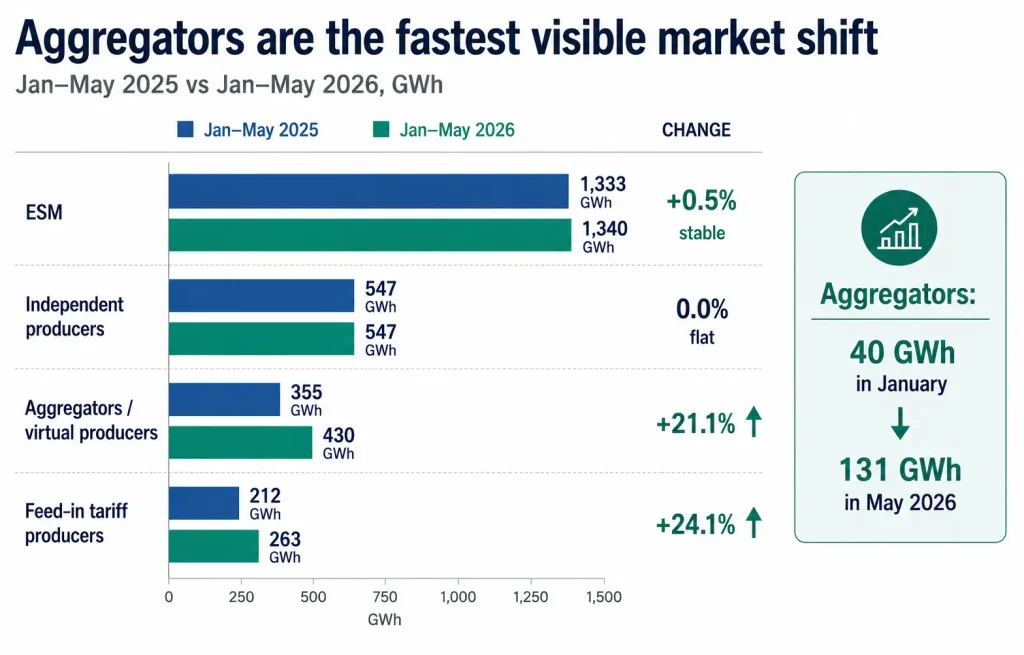
Domestically, the most visible change is the rise of aggregators and virtual producers. In the first five months of 2026, they accounted for around 430 GWh, compared with 355 GWh in the same period of 2025.
The monthly trend is even clearer: in 2026, aggregators increased from 40 GWh in January to 131 GWh in May. This means that a growing share of electricity is being placed through market-based mechanisms.
In addition, MEMO’s analysis of the impact of solar energy on the day-ahead market states that as photovoltaic generation increases, traded DAM volumes also rise. The same analysis notes that the lowest prices occur in April, when consumption is lower and PV generation is higher.
This is important because solar generation under the feed-in tariff category does not show the full solar picture. FIT is an older support scheme. The newer photovoltaic capacity and its market impact should be assessed more broadly through independent producers, aggregators and market participants.
The regional framework is changing
The higher volume on the domestic DAM is taking place at a time when regional electricity trade is also changing.
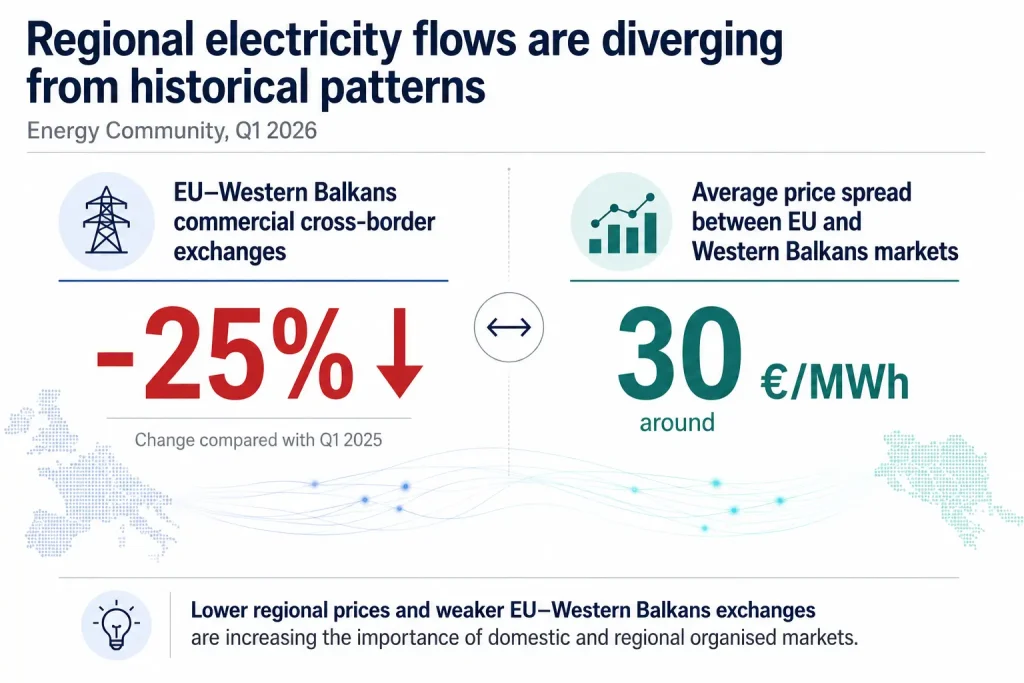
According to the Energy Community, in the first quarter of 2026 commercial cross-border exchanges between the EU and the Western Balkans declined by around 25%, while prices in the Contracting Parties were on average around 30 €/MWh lower than in neighboring EU markets. The report notes that market flows are beginning to diverge from historical trading patterns.
This creates a new regional setting: when cross-border economics change, domestic and regional organised markets become more important. Therefore, the growth of MEMO should not be viewed in isolation, but as part of a broader shift in trading flows, price spreads and the value of transparent market-based electricity trading.
ESM remains the largest producer, but the market is broadening
ESM remains the largest producer in the domestic market structure. In the first five months of 2026, its production was almost unchanged compared with 2025. The difference is that total domestic production was higher, so ESM’s relative share was slightly lower.
This does not indicate a weakening of ESM. It points to a broader market structure. In May 2026, ESM accounted for 44% of domestic production, while aggregators reached 28.6%. That is the clearest signal that the market is becoming more diversified.
Conclusion
The first five months of 2026 show a Macedonian electricity market with greater liquidity, a lower average DAM price and higher domestic coverage of consumption.
The most visible domestic change is the rise of aggregators. They are becoming one of the main channels through which electricity is placed on the market.
At the same time, changing regional flows between the EU and the Western Balkans are increasing the importance of domestic power exchanges and transparent price formation.
That is why 2026 should not be read only as a year with more megawatt-hours traded. The more important message is that North Macedonia’s electricity market is gradually moving towards deeper organized trading, a larger role for aggregators and a stronger link with regional market dynamics.
Viktor Andonov, M.Sc