

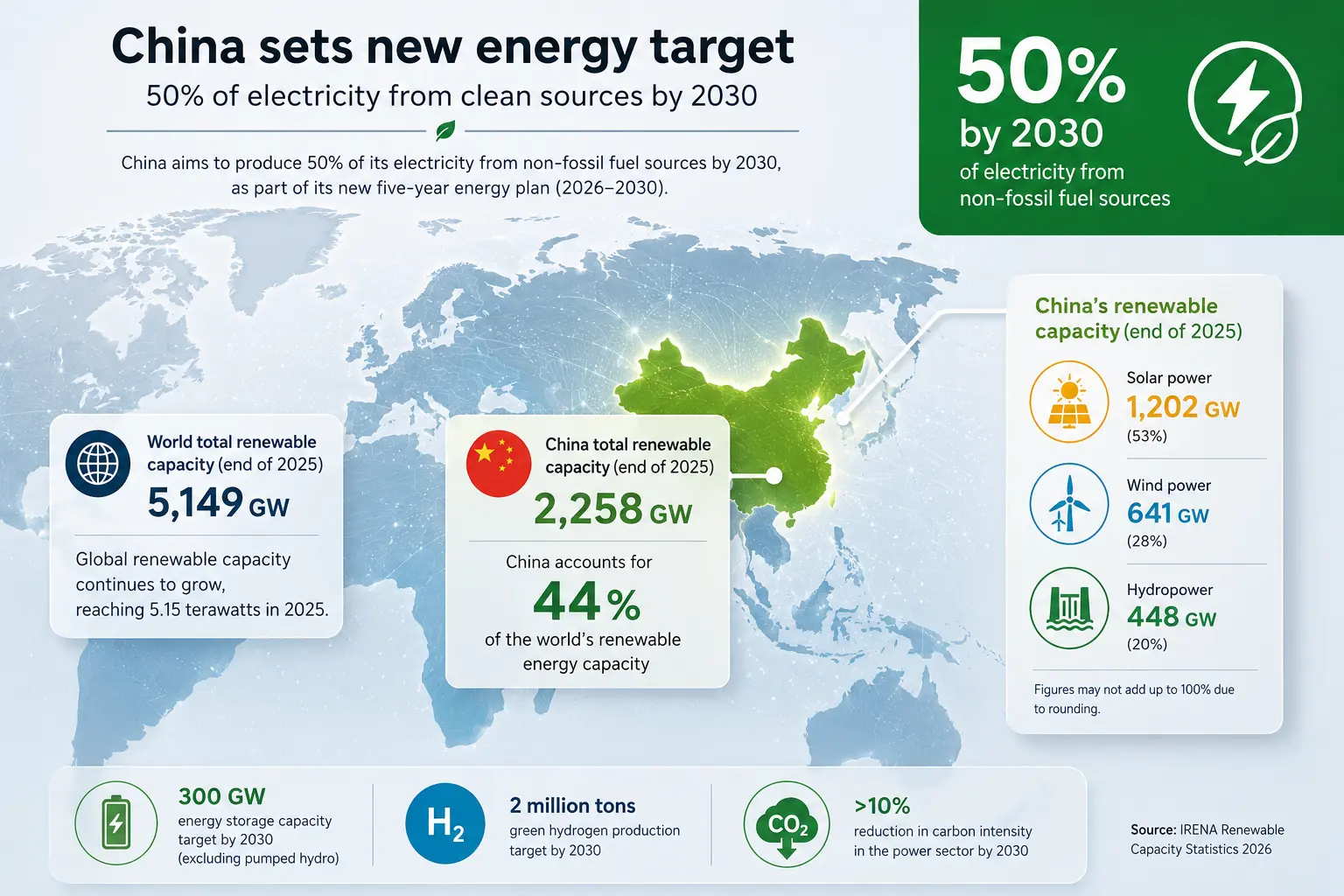
China has set a new strategic target under which 50% of its electricity generation will come from non-fossil energy sources by 2030, Reuters reported, citing the country’s new five-year energy plan.
The new targets are part of China’s 2026–2030 Five-Year Energy Plan, reaffirming the country’s commitment to gradually reducing its reliance on fossil fuels while maintaining the reliability and security of its power system.
New five-year plan prioritizes renewables, batteries and hydrogen, while coal remains key to energy security
The plan envisages wind and solar power accounting for more than half of China’s total installed power generation capacity by the end of the decade. In addition, renewable energy, primarily wind and solar is expected to provide around 30% of total electricity generation, requiring a significantly more flexible and modern electricity system.


Batteries and hydrogen take centre stage
Beyond expanding renewable electricity generation, China’s new strategy places strong emphasis on flexibility technologies.
By 2030, the country plans to:
- Reach 300 GW of energy storage capacity, excluding pumped-storage hydropower;
- Produce around 2 million tonnes of green hydrogen annually;
- Reduce the carbon intensity of the power sector by more than 10%.
These measures are designed to enable greater integration of renewable energy, improve grid stability and gradually reduce greenhouse gas emissions.
Targets are ambitious, but analysts see them as conservative
Interestingly, several analysts believe the official targets are relatively conservative given China’s current pace of renewable energy deployment.
China has been setting global records for new solar and wind installations in recent years, and analysts argue that, if current trends continue, some of the announced targets could be achieved well before 2030. However, slowing investment growth and the challenge of integrating vast amounts of renewable generation into the electricity grid remain significant obstacles.
China accounts for nearly half of the world’s renewable energy capacity
The new target builds on an already impressive renewable energy base that China has developed over the past decade. According to IRENA, the country had 2,258 GW of installed renewable energy capacity by the end of 2025, while global renewable capacity reached 5,149 GW. This means that around 44% of the world’s installed renewable energy capacity is located in China, making it by far the world’s largest market and investor in clean energy. Of China’s total renewable capacity, approximately 1,202 GW is solar power, 641 GW is wind power and 448 GW is hydropower, underlining the country’s leading role in the global energy transition.
Coal remains a pillar of energy security
Despite the rapid expansion of renewable energy, China is not turning away from coal.
The new plan once again identifies coal as a critical component of ensuring a reliable electricity supply, particularly during periods of peak demand or when wind and solar generation is limited. At the same time, the country continues to invest heavily in grid modernisation, battery storage and transmission infrastructure to increase the share of clean energy without compromising system reliability.
China remains a driver of the global energy transition
With its new strategy, China is sending a clear signal that the energy transition remains one of the key pillars of its long-term economic development. While the country remains the world’s largest consumer of coal and the largest emitter of carbon dioxide, it is also by far the world’s largest investor in renewable energy, battery storage, electricity grids and green hydrogen technologies.
How China implements this strategy over the coming years will have a profound impact on the global energy transition, the cost of clean energy technologies and the pace of decarbonization across the world economy.
Source: Reuters
ECI