

The rapid development of artificial intelligence is opening one of the most important energy questions of this decade: how to secure enough electricity for new data centers, but also how to make better use of the energy they already consume.
Data centers are no longer just digital infrastructure. They are becoming major consumers of electricity, water and grid capacity.
At the same time, new research and practical examples show that they can also become part of the energy transition, if their waste heat is used instead of being released into the environment.


Electricity is becoming central to the AI race
According to the Financial Times, the global expansion of data centеrс, driven by artificial intelligence, is creating a huge new demand for electricity.
The key question is no longer only who has the most powerful chips and AI models, but who can secure enough reliable, continuous and competitive electricity.
Estimates cited by the FT show that global data centre capacity could reach 220 GW by 2030, six times higher than in 2020.
Electricity demand from data centres could reach up to 1,400 TWh per year, according to McKinsey estimates cited in the analysis.
This is changing the role of power systems. Data centers operate 24 hours a day and require stable supply, grid connections, transformers, cooling and reserve capacity. That is why AI infrastructure is increasingly becoming an energy issue.
The United States, China and Europe are taking different energy approaches
The United States, China and Europe are entering the same AI race, but with different energy strategies.
In the United States, the main challenge is speed. Data centers require large amounts of electricity immediately, while new grid connections and transmission infrastructure often lag behind. As a result, some projects are being paired with new natural gas power plants or on-site power generation, as gas can provide reliable capacity more quickly.
China is relying on centralised planning. Through its “Eastern Data, Western Computing” strategy, part of its data centre capacity is being shifted to western regions, where there is more available land, renewable energy and a cooler climate. Even there, however, the key challenge remains ensuring that data centres are supported by sufficient clean electricity and grid infrastructure.
Europe is pursuing a different path. The European Commission aims to significantly expand the EU’s data centre capacity while placing greater emphasis on energy efficiency, renewable energy and the reuse of waste heat.
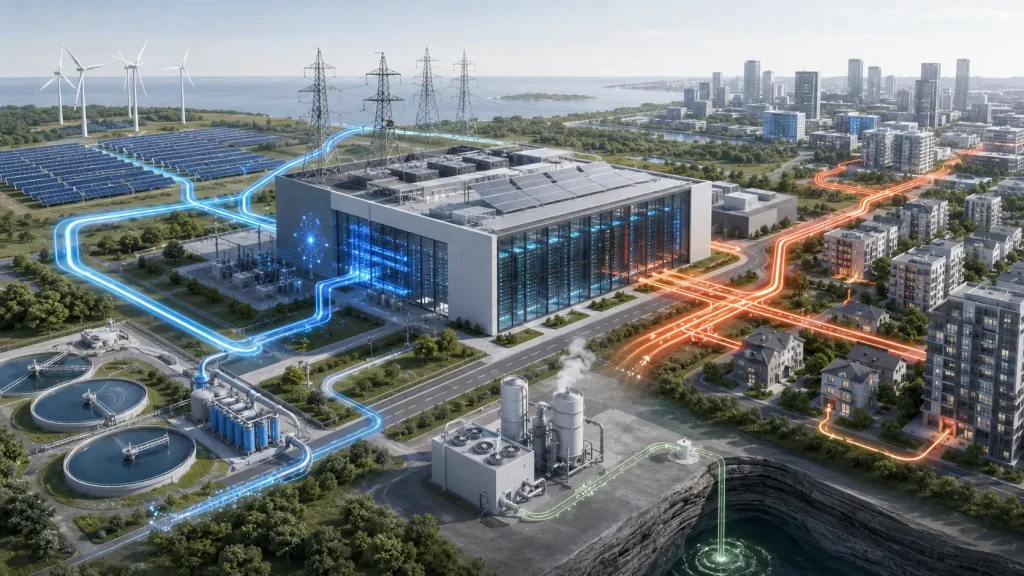
Rather than focusing only on supplying more electricity, the European approach seeks to integrate data centers into the wider energy system using waste heat for district heating, and potentially in the future for water purification and carbon capture.
A large share of energy ends up as heat
One of the most important, but often overlooked, aspects is waste heat. Data centers use electricity to operate servers, chips and cooling systems.
In the end, a large share of that energy is converted into heat.
Until recently, this was mainly treated as a technical problem: heat had to be removed in order to protect the equipment.
But the new approach is different. If data centres already generate large amounts of low-temperature heat, the question is whether that heat can be reused.
European Commission: waste heat can purify water and capture CO₂
A publication by the European Commission’s Directorate-General for Environment shows that waste heat from AI data centers could have a new use.
According to the European Commission, by 2030 data centres could consume 3 to 4% of global electricity, and by 2027 around 5 billion cubic metres of water per year.
The research analyses how low-temperature waste heat, usually between 30 and 70°C, could be used for two applications: thermal water purification and direct capture of carbon dioxide from the air.
This does not mean that every data centre can immediately become a source of clean water or a CO₂ capture system. The European Commission clearly states that technical challenges remain.
The temperature of waste heat is not always sufficient for high system efficiency, and safe cooling of chips must also be ensured.
But the idea is important: data centers do not have to be only consumers of resources. With the right design, they can become part of a wider system in which the same energy serves multiple purposes.
Finland is already using waste heat for heating
The example of Fortum in Finland shows that this is not only theory. The company already uses waste heat from smaller data centers and other sources in district heating systems, and in cooperation with Microsoft it is developing a larger project in the Helsinki region.
According to Fortum, waste heat and heat pumps already provide almost one quarter of the heat in the network area, and with the inclusion of waste heat from Microsoft’s future data centres, that share is expected to rise to around 65%.
The project mentions the Kolabacken and Hepokorpi data centres, whose heat is expected to provide district heating for a significant share of consumers in Espoo, Kirkkonummi and Kauniainen. It is a practical example of how digital infrastructure can be connected with the local energy system.
From problem to resource
This is the essential shift. Data centers will certainly create new pressure on power systems. They will require more electricity, more grid connections, more network infrastructure and better planning.
At the same time, they can also create new opportunities. Waste heat can be used for district heating, and in the future potentially also for water purification or CO₂ capture.
This does not fully solve the problem of high energy consumption, but it improves the overall efficiency of the system.
The most important lesson is that data centers should not be planned in isolation. They should be seen as part of energy infrastructure: connected to the grid, renewable energy sources, heating systems, water resources and the local needs of cities.
The new measure: not only how much they consume, but what they create
Until now, the main question was how much electricity data centers consume. In the future, the question will be broader: what do they create with that energy?
If a data centers consumes large amounts of electricity, but its waste heat is used for heating, water or other processes, then it has a different role in the energy system. It does not automatically become “green”, but it becomes more efficient and more useful for the environment in which it operates.
That is why the next phase of AI infrastructure development will not depend only on servers, chips and software. It will also depend on power grids, the availability of clean energy, the use of waste heat and the ability of data centres to fit into local energy systems.
AI data centers will be a major challenge for the energy sector. But if they are planned properly, they can also become part of the solution.
Viktor Andonov, M.Sc