


Finance Think organized the roundtable discussion “Powering Competitiveness: Energy Transition, CBAM and the Future of Macedonian Industry,” during which the study “CBAM Readiness and the Green Industrial Transition in North Macedonia” was presented.
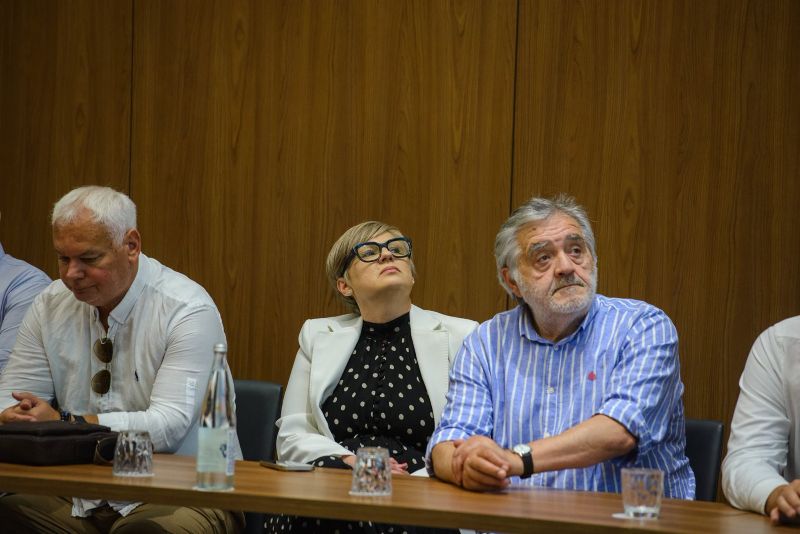
The event brought together representatives of public institutions, local governments, industry, and the energy sector to discuss how the energy transition and emerging European climate regulations will affect competitiveness, investment, and the future development of the Macedonian economy.

The study highlights that CBAM can no longer be viewed solely as a technical or environmental obligation. For North Macedonian companies, especially industrial exporters, it is becoming a matter of market access, production costs, industrial transformation, and long-term competitiveness.


EUR 478 Million of Exports Covered by CBAM
According to the study, North Macedonia remains exposed to CBAM due to the concentration of exports in emissions-intensive sectors such as iron and steel, metals, electricity, and cement. In 2025, exports covered by CBAM reached approximately EUR 478 million, representing 7.7% of exports to the European Union.
This demonstrates that European climate policies will directly affect some of the country’s most important industrial sectors. For companies, this means that alongside price, quality, and delivery reliability, the carbon footprint of production will increasingly become a key competitive factor.
Decarbonization Is Becoming an Economic Issue, Not Only an Environmental One
One of the study’s main conclusions is that companies increasingly view decarbonization as a matter of competitiveness and market access rather than solely an environmental obligation. Export-oriented firms are already facing growing demands from European customers regarding emissions reporting, renewable electricity sourcing, and greater transparency throughout supply chains.

This is changing the logic of industrial policy. The energy transition is no longer only about building new power plants; it is also about modernizing production processes, securing access to affordable low-carbon electricity, investing in energy efficiency, and aligning with European standards.
Large Companies Are Adapting Faster
The study indicates that the transition is progressing unevenly. Large exporters and energy-intensive companies are investing more rapidly in renewable self-generation, energy-efficiency improvements, and emissions monitoring systems.
At the same time, small and medium-sized enterprises face greater challenges. Their most common barriers include limited access to finance, insufficient technical expertise, administrative complexity, regulatory uncertainty, and a lack of capacity to prepare and implement investment projects.

This creates a risk that part of the domestic supplier base and smaller companies could fall behind in adapting to the new European requirements, potentially affecting their position within regional and European value chains.
Coal Remains an Important Part of the Energy System
Although renewable energy deployment has accelerated significantly in recent years, the study notes that the electricity system remains substantially dependent on coal. In 2025, thermal power plants accounted for 35.4% of domestic electricity generation, while hydropower represented 21.6%, solar power 19.3%, and combined heat and power plants 18.2%.
This is also important for industry, as access to low-carbon electricity is becoming an increasingly important factor for the competitiveness of products exported to the EU market.
Investments in Grids, Storage and Industrial Modernization Are Needed
The study notes that North Macedonia has set ambitious targets for 2030, including a 42.2% reduction in greenhouse gas emissions compared to 1990 levels and achieving a 31.6% share of renewable energy in gross final energy consumption.
Achieving these goals will require significant investments in renewable energy, electricity networks, battery storage systems, industrial decarbonization, energy efficiency, electrification, and workforce reskilling.
Among the instruments highlighted in the study are long-term power purchase agreements (PPAs), contracts for difference (CfDs), competitive renewable energy auctions, grid modernization and digitalization, simplified permitting procedures, and stronger support mechanisms for companies lacking sufficient financial and technical capacity.
Energy Transition as a Development Opportunity
The message from the roundtable is that the energy transition should not be seen only as a cost or an obligation toward the EU, but as an opportunity for new industrial development. If managed in a coordinated way, it can bring stronger competitiveness, new investment, modernization of production and stronger local economic development.
The key challenge for North Macedonia will be to connect climate policy, industrial policy, energy reforms and support for companies in time. Only in this way can CBAM be transformed from a risk for exporters into an incentive for faster modernization of Macedonian industry.
Editorial Office