

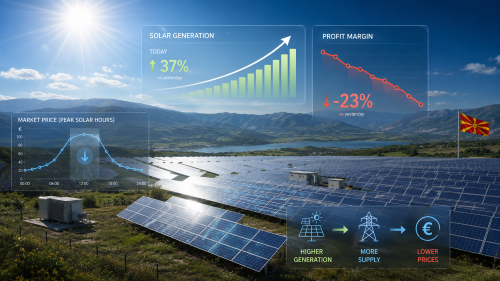
The sector for electricity production from renewable energy sources in Macedonia is entering a new phase. It is no longer only about building photovoltaic power plants, but about a business in which profit will increasingly depend on market sales, forecasting, balancing responsibility and battery storage systems.
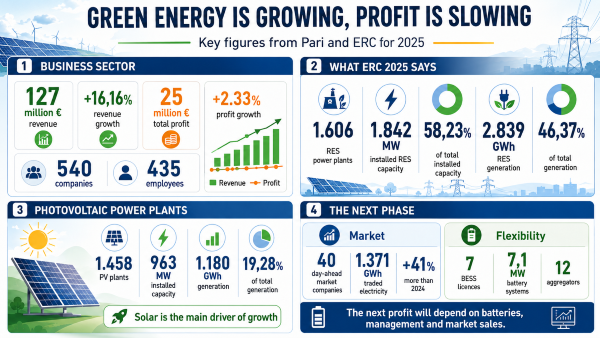
According to the analysis by “Pari”, companies producing electricity from renewable energy sources generated €127 million in revenue in 2025, an increase of 16.16% compared with the previous year. However, their combined profit increased by only 2.33%, reaching around €25 million.
These revenues were generated by 540 companies, while only 435 people were employed in the sector, showing that green energy is a capital-intensive rather than a labor-intensive business.


Revenues Are Growing, but Profit Is Slowing Down
At first glance, the growth in revenues looks strong. However, what matters more is that profit is growing much more slowly than revenues. This means that the sector is producing and selling more electricity, but margins are under greater pressure.
The reason is not only the price of electricity. It is a change in the entire business model. In the first phase, investors mainly focused on building photovoltaic power plants and connecting them to the grid. In the next phase, that will no longer be enough.
A growing share of production is coming in the same hours, especially around midday, when photovoltaic power plants generate the most electricity.
When many producers sell electricity at the same time, the market value of that electricity declines. That is why there can be higher production and higher revenue, but not the same growth in profit.
ERC Confirms: Solar Has Become the Main Driver of Growth
The 2025 Annual Report of the Energy and Water Services Regulatory Commission shows the system-wide change behind these financial results. The country has 1,606 power plants using renewable energy sources, with a total installed capacity of 1,842 MW.
This represents 58.23% of the country’s total installed capacity. Electricity production from renewable sources amounted to 2,839 GWh, or 46.37% of total electricity production.
The biggest change is in photovoltaic power plants. According to ERC, in 2025 there were 1,458 photovoltaic power plants, with 963 MW of installed capacity and production of 1,180 GWh.
They accounted for 30.44% of total installed capacity and 19.28% of total electricity production.
These figures show that photovoltaic power plants are no longer a secondary source. They have become one of the main pillars of domestic electricity production. But this is exactly what creates a new challenge: how to manage such a large solar capacity in a system that still lacks sufficient flexibility.
The Market Is Becoming More Important Than Production Itself
ERC shows that the Macedonian electricity exchange is gaining an increasingly important role. By December 2025, there were 40 registered companies on the day-ahead market, while the total traded electricity reached 1,371 GWh, which is 41% more than in 2024.
This is an important signal. As the number of photovoltaic power plants increases, producers will need to rely not only on physical generation, but also on market strategy. Profit will increasingly depend on when electricity is sold, at what price, under what type of contract and with what level of balancing risk.
That is why the next phase of the green energy business will not be won only by those who build power plants. It will be won by those who know how to manage production, forecasting, sales and storage.
Imbalances Are Becoming a Major Financial Burden
One of the most important pieces of data in the ERC report is the financial implication of deviations by balance groups. In 2025, negative deviations amounted to 2,926,060,181 denars, or around €47.58 million. Positive deviations generated 1,529,699,366 denars, or around €24.87 million.
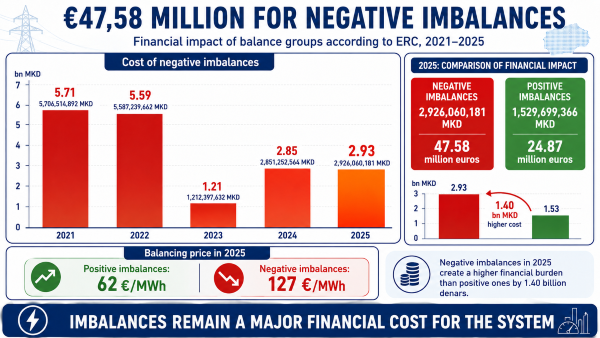
This means that negative deviations created a financial burden that was around 1.4 billion denars higher than the positive effect. In addition, the average balancing price in 2025 was €62/MWh for positive deviations and €127/MWh for negative deviations.
This figure is crucial for understanding future profitability. If a producer does not have good forecasting, a battery system or proper management through a balance group, part of the revenue can be lost through deviation costs.
Batteries Are Becoming an Economic Necessity, Not Only a Technical Solution
ERC states that in 2025, for the first time, seven licences were issued for electricity storage facilities within photovoltaic power plants, with a total installed battery capacity of 7.1 MW. By the end of 2025, 12 aggregators had also been registered. They manage electricity production and/or consumption from the producers and consumers they integrate.
This is the beginning of a new model. Batteries are not important only because they help the system. They are becoming an economic instrument. With batteries, producers can avoid selling part of their daytime solar production immediately, when everyone else is selling, and instead shift it to hours with higher prices.
At the same time, batteries can help reduce deviations and improve portfolio management.
In conditions where photovoltaic power plants generate electricity with a similar time profile, storage becomes a way to protect the value of the electricity produced.
Profit Is Concentrated Among the Largest Players
“Pari” shows that around 49.3% of all revenues in the sector are concentrated among the ten largest companies, which generated €62.6 million in revenue. Profit concentration is even stronger: the top 10 most profitable companies recorded €15.4 million in profit, which is more than 61% of the sector’s total profit. EVN Macedonia Elektrani alone recorded €11.3 million in profit, or 45.2% of the total earnings in a sector represented by 540 companies.
This shows that green energy is open to many investors, but the economic benefit is not evenly distributed. Large companies have better access to financing, larger portfolios, stronger contracts, lower operating costs and a greater ability to manage risk.
Smaller producers will have to adapt through aggregators, batteries, better forecasting and more sophisticated sales models.
A More Difficult, but More Mature Phase Is Coming
Green energy in Macedonia is already a serious business. But 2025 shows that the sector is entering a more difficult and more mature phase.
The first phase was the construction of power plants. The second phase will be the management of the value of electricity.
This means that future profit will not depend only on how many MW are built. It will depend on who has batteries, who has better forecasting, who has fewer deviations, who sells in the right hours and who knows how to manage market risk.
That is why the main message is clear: green energy remains a business with major potential, but the easy part is over. The next phase will be one in which profit is created not only by producers, but also by those who know how to manage energy.
Viktor Andonov, M.Sc