

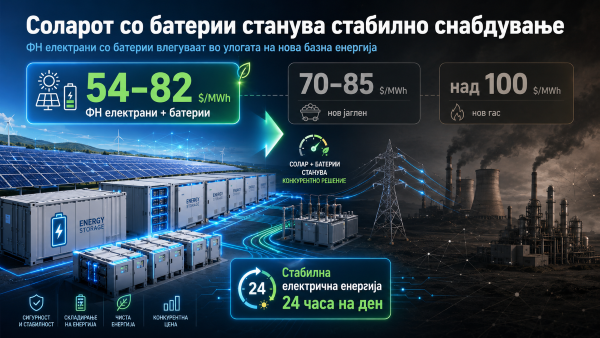
Photovoltaic power plants combined with battery systems are no longer just an additional source of electricity. New analyses show that in regions with strong solar and wind potential, they can provide stable electricity 24 hours a day, at costs that are competitive with coal and natural gas.
For many years, the main argument against renewable energy sources was their variability. Solar power plants produce the most electricity during the day, wind power plants depend on weather conditions, while conventional coal and gas power plants were considered irreplaceable when it came to stable electricity supply.
But that assumption is changing rapidly. A new report by the International Renewable Energy Agency, IRENA, shows that solar and wind power plants, when combined with battery storage, can already provide electricity available 24 hours a day at competitive costs. According to IRENA, in regions with favourable natural conditions, such hybrid systems can deliver stable electricity at a lower cost than fossil fuels.


The old divide between renewable and baseload energy is breaking down
The key change lies in batteries. Without storage, photovoltaic power plants remain a strong but daytime source of generation. With battery systems, part of the low-cost electricity produced during the day can be used in the evening hours, when demand increases and solar generation declines.
This is precisely why solar with batteries is beginning to enter the role traditionally reserved for coal and gas: stable supply. IRENA estimates that the cost of stable electricity from photovoltaic power plants with batteries in regions with high solar potential ranges from 54 to 82 dollars per megawatt-hour. By comparison, new coal-fired power plants in major markets are estimated at around 70 to 85 dollars per megawatt-hour, while new gas-fired power plants globally may exceed 100 dollars per megawatt-hour.
This does not mean that every power system can immediately rely entirely on solar and batteries. But it does mean that the economic logic is changing. Renewable energy sources are no longer only the cheapest new source of electricity; they are becoming a real system-level alternative for stable supply.
IRENA Director-General: The argument about unreliability no longer applies
IRENA Director-General Francesco La Camera describes the shift very directly. According to him, electricity from renewable sources available 24 hours a day is already competitive with fossil fuels, while the long-standing argument that renewables are not reliable enough “no longer applies.” He emphasises that renewables today can provide reliable electricity throughout the day and night, while oil and gas markets remain exposed to geopolitical shocks and price volatility.
In an interview with Forbes, La Camera further pointed out that renewables are not only cheaper, but also faster to build than many conventional energy capacities. According to him, in a system where electricity demand is growing, it is logical to choose a solution that is cheaper and can be deployed more quickly.
Batteries are changing the entire economics
The most important factor in this transformation is the decline in costs. Since 2010, according to IRENA, total installed costs for photovoltaic power plants have fallen by 87%, for onshore wind power plants by 55%, and for battery storage by as much as 93%. This is exactly what makes the new model possible: low-cost generation plus low-cost storage.
IRENA expects costs to decline further over the next decade. At the best locations, stable electricity from renewable sources could fall below 50 dollars per megawatt-hour by the mid-2030s.
This is a major change for power systems. Until now, fossil fuels had the advantage of reliability, while renewables had the advantage of low cost. With batteries, that division is beginning to disappear.
The next problem is not generation, but the grid
However, this transition cannot happen only by building new photovoltaic power plants. The next constraint will be the grid. Transmission and distribution systems in many countries were not designed for a large number of decentralised sources, batteries and variable electricity flows.
Forbes notes in its analysis that without modernisation, bottlenecks in the transmission grid, rather than a lack of generation, will slow down development. At the same time, electricity demand is increasing due to electrification, industrial development, data centres and artificial intelligence.
That is why the next phase in the energy sector will not be only about who builds more megawatts. It will be about who builds a better system: the grid, batteries, demand-side management and market rules that reward flexibility.
Editorial Office