


The world is entering the Age of Electricity
The latest Global Energy Review 2026 by the International Energy Agency shows that the global energy system is entering a new phase of structural transformation. In 2025, total energy demand increased by 1.3%, marking a slowdown compared with the previous year. However, electricity demand grew by around 3%, more than twice as fast as total energy demand.
This figure confirms the report’s main message: the world is already entering the Age of Electricity. The electrification of transport, industry, buildings, data centres and households is becoming one of the most important drivers of the global economy.
At the same time, low-emissions sources solar PV, wind power, hydropower, nuclear energy and other renewables accounted for nearly 60% of the growth in global energy demand.


1. Solar PV became the largest source of growth
The strongest trend in 2025 was the historic growth of electricity generation from solar PV. Solar electricity generation increased by 600 TWh, the largest annual increase ever recorded for any source of electricity, excluding periods of recovery after global crises.
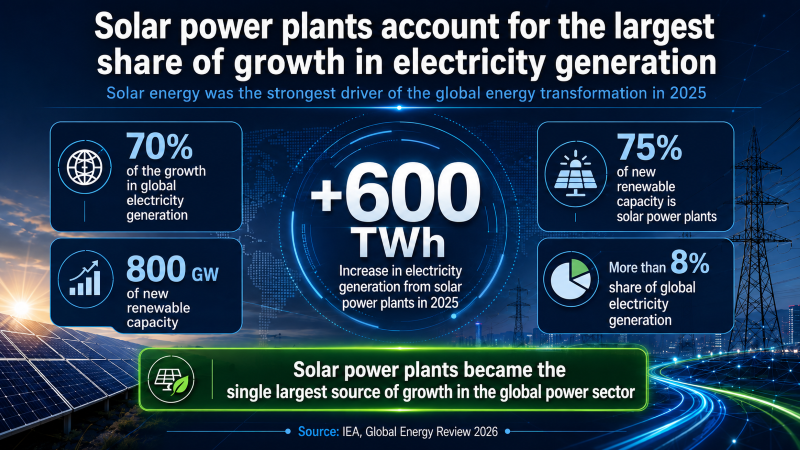
Solar PV alone accounted for around 70% of the growth in global electricity generation. Its share in total global electricity generation exceeded 8%, while total electricity production from solar PV reached nearly 2,700 TWh.
The growth in new capacity was also record-breaking. In 2025, around 800 GW of new renewable capacity was added globally, of which around 75% came from solar PV. This shows that solar energy is no longer a peripheral technology, but a central part of the new electricity system.
At the same time, renewables globally almost matched electricity generation from coal. In the European Union, the combined share of solar PV and wind power reached 30% of electricity generation, surpassing fossil fuels for the first time.
2. Data centres are growing rapidly, but they are not the only driver of demand
Digitalization, artificial intelligence and the expansion of data centers are creating new pressure on electricity systems. In 2025, electricity consumption from data centers increased by around 17%.
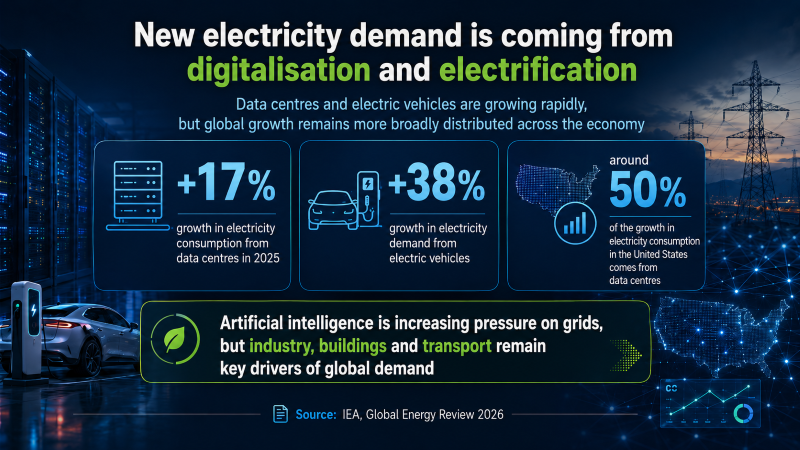
However, the report shows that their global impact should be assessed precisely. Data centres are an important and fast-growing segment, but they still represent a smaller part of the overall increase in global electricity demand. Most of the growth comes from buildings, industry, household appliances, heating, cooling and transport.
The United States is a specific example. There, data centers accounted for around half of the total growth in electricity consumption in 2025. This shows that the effect of artificial intelligence and digital infrastructure will be especially important in countries with a strong concentration of technology companies and large data-processing centers.
3. Electric vehicles are changing the link between economic growth and oil
Sales of electric cars increased by more than 20% in 2025, reaching around 21 million vehicles sold. This means that approximately one in four new cars sold globally was electric.
This trend is already having a clear impact on oil demand. Global oil demand increased by only 0.7%, or around 0.65 million barrels per day, significantly below the average annual growth recorded during the 2010–2019 period.
China is the most important example of this shift. Although the Chinese economy expanded strongly between 2021 and 2025, oil consumption in road transport remained almost unchanged. The reasons are the rapid electrification of the vehicle fleet, greater use of natural gas trucks and the development of high-speed rail.
In the European Union, sales of electric cars increased by 30% in 2025. Europe as a whole overtook China as the fastest-growing major market for electric cars, while in Norway battery-electric cars reached a record share of 96% of all new cars sold.
4. Batteries are becoming a pillar of electricity system flexibility
Battery storage was the fastest-growing energy technology in 2025. New storage capacity increased by around 40%, reaching nearly 110 GW. This is higher than the largest annual increase ever recorded for new natural gas capacity.
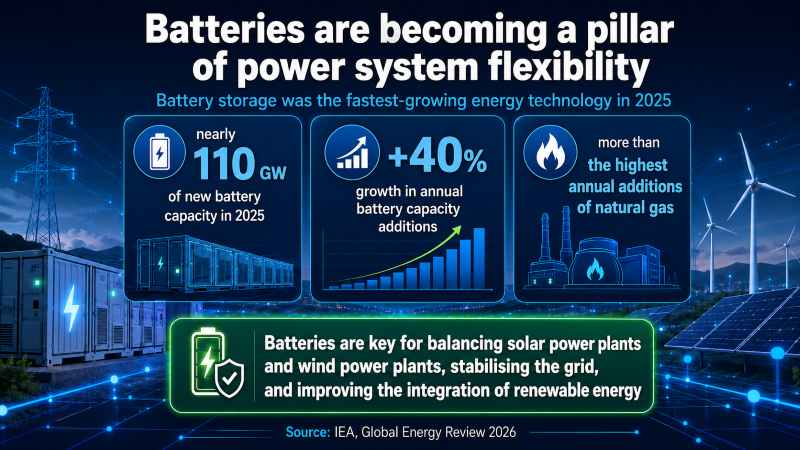
This is a crucial shift for electricity systems. As the share of solar PV and wind power increases, so does the need for flexibility, storage and rapid system response. Batteries make it possible to absorb surplus generation, deliver electricity during hours of higher demand and stabilise the grid.
That is why batteries should no longer be seen only as an additional technology. They are becoming an infrastructure element of the new energy system, together with grids, demand-side management and digital balancing systems.
5. Clean energy is slowing the growth of CO₂ emissions
Global energy-related CO₂ emissions increased by around 0.4% in 2025, significantly more slowly than total energy demand, which grew by 1.3%. Although emissions still reached a new record level of more than 38 billion tonnes, their growth continues to slow.
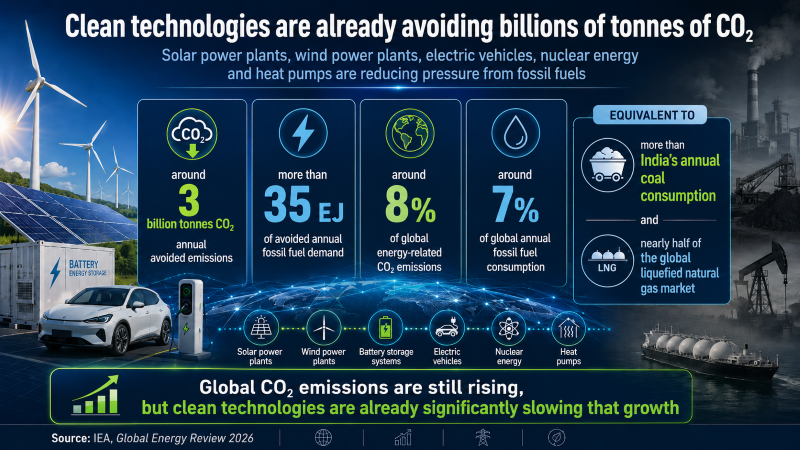
The main reason is the rapid expansion of clean technologies. According to the report, technologies installed since 2019 solar PV, wind power, nuclear energy, electric cars and heat pumps, avoided more than 35 EJ of annual fossil fuel demand in 2025. This is around 7% of global annual fossil fuel consumption.
The same technologies prevented around 3 billion tonnes of CO₂ emissions annually, equivalent to approximately 8% of global emissions. The avoided coal demand is greater than India’s total annual coal consumption, while the avoided demand for natural gas is equivalent to nearly half of the global liquefied natural gas market.
China recorded a decline in energy-related CO₂ emissions of around 0.5%, mainly due to strong growth in renewables, reduced coal use in electricity generation and structural changes in energy-intensive industry. In India, emissions remained almost unchanged for the first time since the 1970s, due to a combination of a strong monsoon, higher hydropower output and growth in renewables.
Clean technologies already have a measurable impact
The new energy reality has already begun
The global energy system is no longer in the early stage of transition. The data for 2025 show that the world is already operating in a new energy reality, in which electricity, solar PV, batteries, electric vehicles and low-emissions technologies play a central role.
However, the report also shows that the transition is not linear and is not without risks. Extreme weather events, weak hydrology, insufficient wind generation in certain periods and higher natural gas consumption during winter show that electricity systems will need to invest much more in grids, batteries, flexibility and energy efficiency.
The main message is clear: clean energy is already changing the global energy economy, but the next phase will depend on how quickly countries modernize their grids and create systems capable of reliably integrating a high share of renewable energy sources.
Viktor Andonov, M.Sc