

On 11 November 2026, the Energy Community Secretariat published new guidelines aimed at accelerating renewable energy development in the Western Balkans, with a particular focus on spatial planning, permitting procedures and coordination among the relevant institutions.
According to the published data, the six Western Balkan economies had approximately 23 GW of solar and wind projects under development in 2024. At the same time, their National Energy and Climate Plans envisage the construction of approximately 10 GW of additional capacity by 2030.
The Energy Community points out that lengthy and complex administrative procedures are among the significant obstacles preventing investment plans from being translated into operational electricity generation capacity.


Renewable acceleration areas instead of lengthy individual permitting procedures
The central recommendation of the new document is the establishment of renewable acceleration areas, in line with the approach introduced under the revised EU Renewable Energy Directive (RED III).
Rather than addressing all spatial, environmental and infrastructure-related issues only after individual investment applications have been submitted, the competent authorities should identify in advance the areas suitable for the development of solar and wind power plants.
The designation of these areas should take into account electricity generation potential, biodiversity protection, land use, access to the electricity grid and potential impacts on local communities.
Particular priority is recommended for former mining sites, industrial complexes and degraded land, where potential conflicts over land use may be less significant.
Assessments carried out in advance should provide greater predictability for investors and reduce the duplication of administrative procedures.
The Energy Community emphasises that the RED III provisions concerning renewable acceleration areas are not yet fully legally binding for the region under the Energy Community Treaty. Countries are therefore encouraged to begin preparations using existing spatial plans, available data and pilot projects, without waiting for the legal alignment process to be completed.
Bitola and Elbasan as pilot areas for the energy transition
The new approach is already being implemented through pilot activities in Bitola, North Macedonia, and Elbasan, Albania, with support from the Renewable Energy Acceleration Centre at the Energy Community Secretariat.
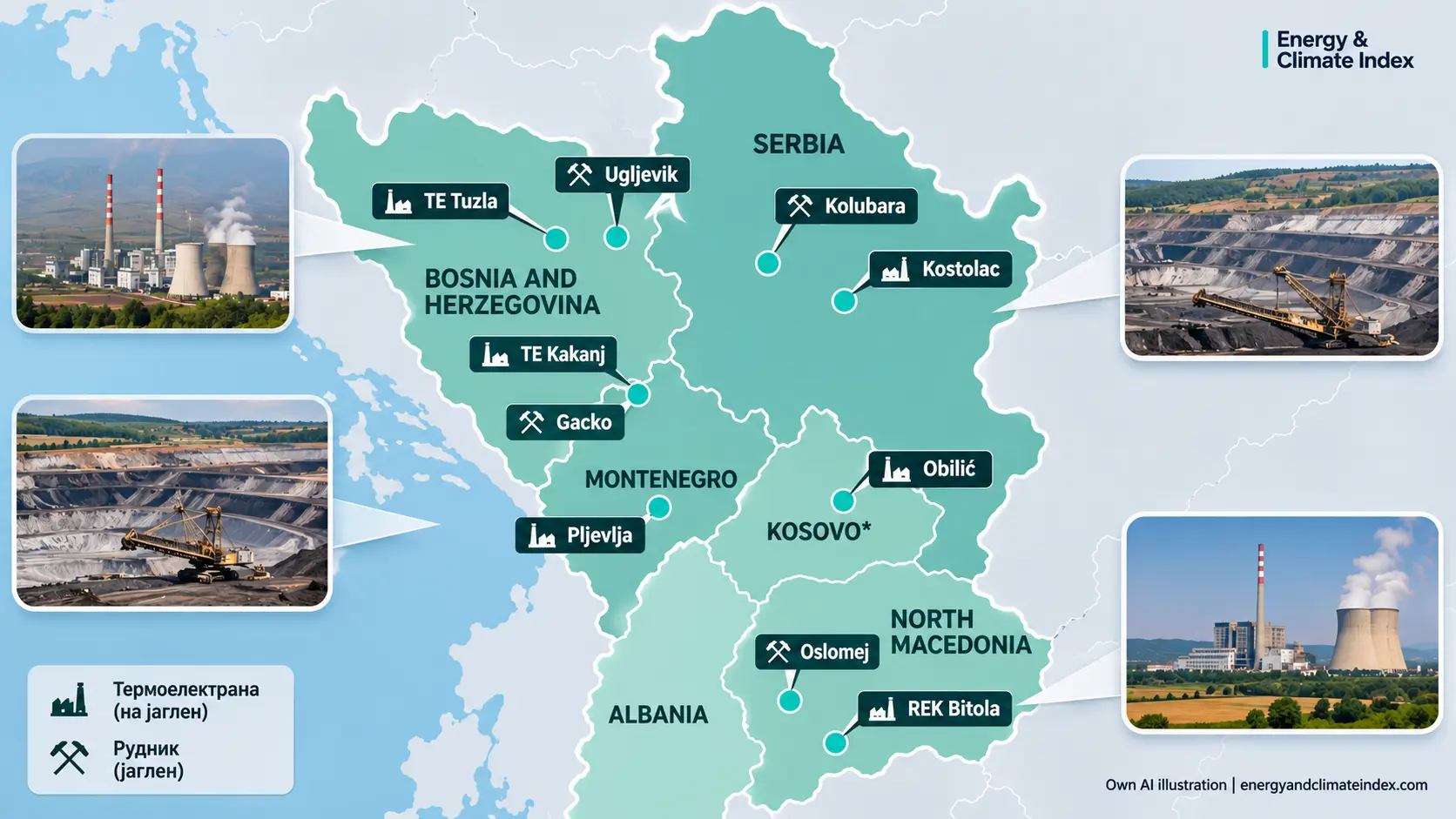
In North Macedonia, the activities focus on the Bitola–Novaci region, which has traditionally been associated with coal mining and electricity generation at the REK Bitola power complex.
The objective is to identify suitable locations for new renewable energy facilities and develop an approach for their implementation within the framework of the just energy transition.
In Albania, the pilot activities are concentrated in Elbasan, where the potential use of former industrial and metallurgical sites for renewable electricity generation and industrial decarbonisation is being explored.
Technical, spatial and environmental assessments are planned for both areas, alongside coordination with local authorities and the relevant institutions.
At this stage, these activities concern site preparation and the development of institutional mechanisms, rather than already approved new power plants with defined installed capacities.
From investment plans to operational power plants
The new guidelines emphasise the need for better coordination among institutions responsible for energy, environmental protection, spatial planning, electricity networks and local development.
The Energy Community recommends the early involvement of local communities, as well as clearly defined conditions under which investors can develop projects within designated areas.
Of particular importance is aligning spatial planning with the actual capacity of electricity networks to accommodate new connections. A location with favourable solar or wind potential does not necessarily have sufficient grid capacity to connect a new power plant.
Therefore, the designation of renewable acceleration areas should also be based on data concerning existing and planned transmission and distribution infrastructure.
This approach could reduce the risk of developing projects in locations where significant grid connection constraints or additional network investment requirements emerge at a later stage.
The key challenge remains translating the large number of announced projects into completed and grid-connected generation facilities, while respecting environmental standards, the interests of local communities and the technical limitations of electricity systems.
ECI