

The analysis by EnergyAndClimateIndex is based on the TOP 100 largest companies ranking published by the economic portal Pari.com.mk, as well as additional official financial data from AD ESM, AD MEPSO, MEMO DOOEL Skopje, and ESM Prodazhba.
The data show that 2025 brings a clear divergence between revenues and profitability in the Macedonian energy sector. In terms of revenues, electricity surpasses oil and becomes the leading energy segment. However, when it comes to profits, the picture is more complex: the electricity sector still generates higher profits than oil companies, but its profitability has declined significantly.
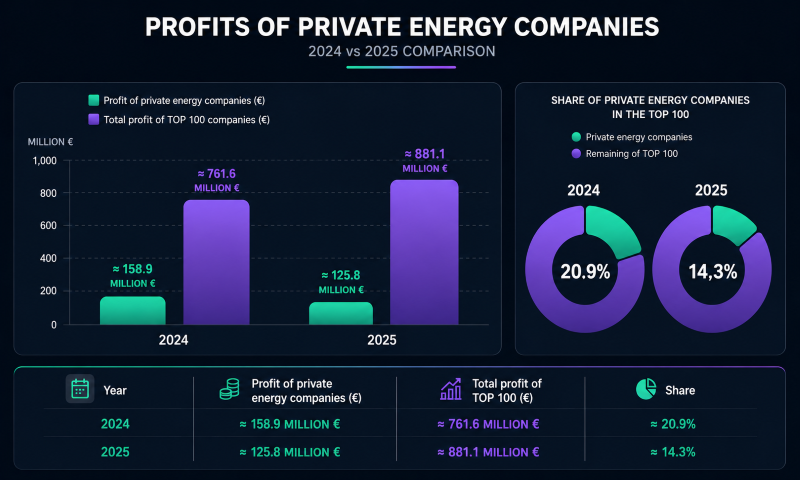
Private energy companies see lower profit share among TOP 100
In 2024, nearly every fifth euro of profit among the TOP 100 companies came from private energy companies. In 2025, that share falls to around 14.3%. This means that the sector remains highly profitable, but with significantly lower margins compared to the previous year.


Electricity remains more profitable than oil, but sees sharp decline
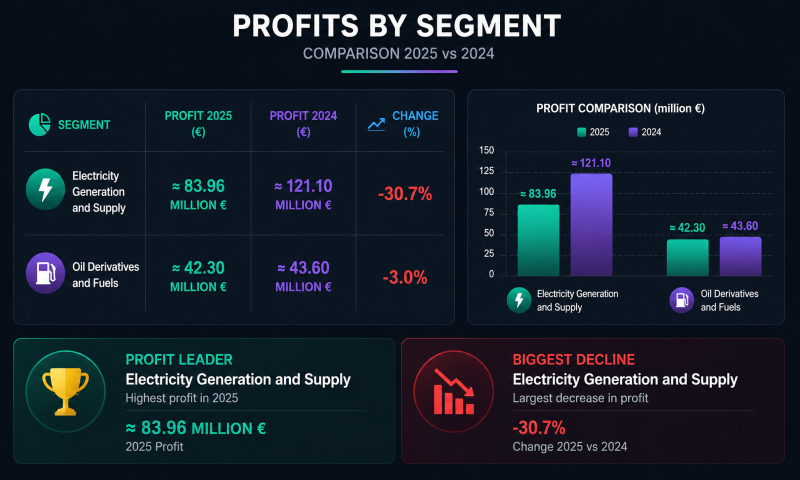
Electricity companies generated around €84 million in profit in 2025, which is roughly twice the profit achieved by companies dealing in petroleum products. However, the decline of more than 30% indicates that revenue growth in the electricity sector does not automatically translate into profit growth. The greatest pressure comes from companies whose profitability directly depends on market prices, electricity production levels, and power procurement costs.
Major changes among power companies
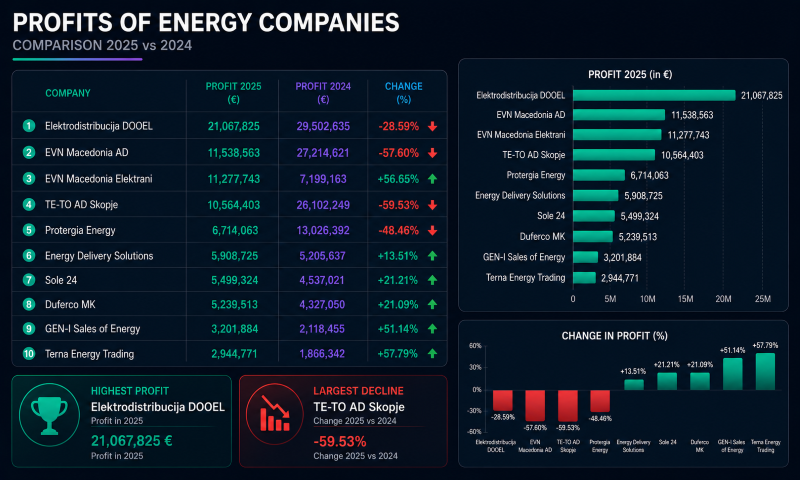
The sharpest decline was recorded by TE-TO AD Skopje and EVN Macedonia AD, which together lost more than €31 million in profit compared to 2024. In the case of TE-TO, the decline is linked to lower production from combined-cycle gas plants and changes in the structure of electricity generation within the system. According to the annual report of the Energy Regulatory Commission, electricity generation from photovoltaic power plants reached 1,180 GWh in 2025, increasing by 27.77%, and for the first time surpassed generation from combined-cycle gas facilities. This means that solar energy is increasingly influencing daytime electricity prices and reducing profit margins for producers that depend on higher market prices.
At EVN, the decline in profitability is associated with greater exposure to market-based procurement. According to the Energy Regulatory Commission, EVN Home procured around 292 GWh of electricity through the organized market in 2025, compared to around 47 GWh in 2024. This means that a larger share of the required electricity is being purchased under market conditions, while household retail prices remain regulated. The result is high revenue, but lower profitability. At the same time, EVN Macedonia Elektrani, GEN-I, and Terna Energy Trading recorded profit growth, indicating that some companies have successfully benefited from increased market activity and the expansion of electricity trading.
Oil sector profits hold steady, but see major internal redistribution
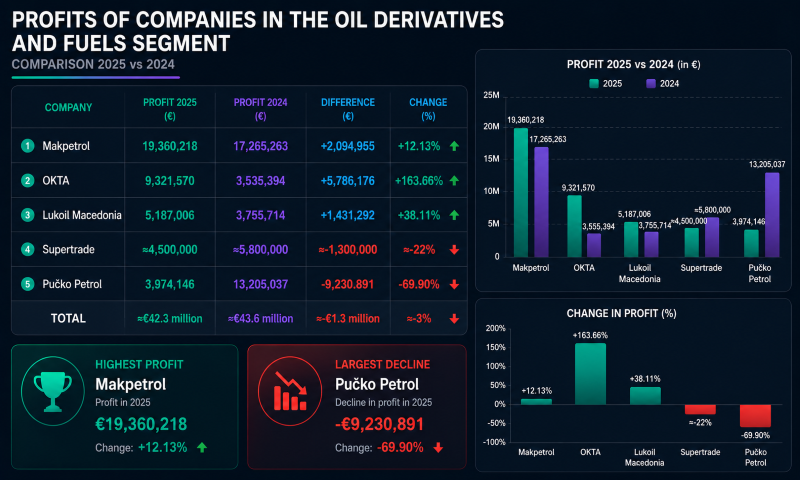
In the petroleum products sector, total profits remained almost unchanged, although the structure changed significantly. OKTA AD Skopje recorded the largest increase in profit, while Makpetrol AD Skopje and Lukoil Macedonia also achieved improved results. However, the decline in profits at Pucko Petrol and Supertrade reduced the overall sectoral effect. This indicates that profitability in the oil sector has not disappeared, but rather has been redistributed among companies. Unlike electricity, where the decline is broader across the sector, profitability in petroleum products depends more on the position and business model of each individual company.
State-owned enterprises shift the entire landscape
State-owned companies significantly alter the overall profitability picture of the energy sector. AD MEPSO, MEMO DOOEL Skopje, and ESM Prodazhba operated with profit, while AD ESM continued to operate at a loss.
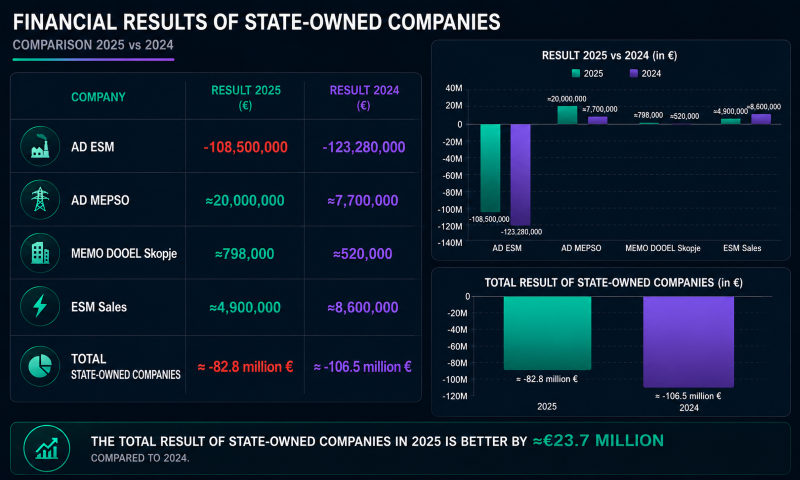
Although the loss of AD ESM declined from around €123.3 million in 2024 to approximately €108.5 million in 2025, this improvement does not mean that state-owned generation has become profitable. On the contrary, the reduction in losses is mainly linked to lower production from thermal power plants, meaning lower exposure to the most expensive part of the generation portfolio. According to the analyzed data, electricity production from thermal power plants declined by around 10% compared to 2024.
Thermal power plants remain the largest financial burden within the state energy system. High production costs, declining competitiveness amid the rapid growth of solar energy, and the need for the system to maintain security of supply continue to place significant pressure on the financial performance of AD ESM.
Final Conclusion
The year 2025 clearly demonstrates a structural division within the Macedonian energy sector. In terms of revenues, electricity has overtaken oil and become the leading energy segment. However, in terms of profits, the electricity sector is facing a substantial decline in profitability.
The oil sector operates on a smaller scale than electricity, but it has managed to maintain profits at a relatively stable level. Meanwhile, the state-owned part of the electricity sector remains the largest financial challenge, primarily due to the losses of AD ESM and the high costs of thermal generation.
The main message is clear: the Macedonian energy sector is moving toward larger market volumes and a greater role for electricity, but future profitability will increasingly depend on which companies can achieve more efficient production, better cost management, and stronger adaptability to the growth of renewable energy sources.
Viktor Andonov, M.Sc